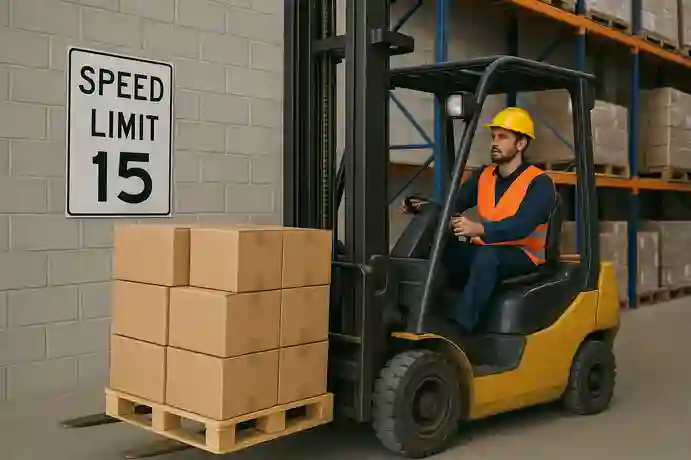
If you’ve ever worked in a warehouse or factory where forklifts zip around all day, you know speed is one of the most misunderstood—and most argued about—topics on the floor.
Some operators think they’re in Fast & Furious.
Some supervisors want you crawling at walking speed.
And OSHA? Well… OSHA doesn’t actually give a specific number at all.
So what’s the real forklift speed limit inside a factory? How fast is too fast? And who decides?
Let me break it down the way we explain it during operator training — straight talk, grounded in experience, and without the boring corporate jargon.
(See below the ways how to determine the speed limit in your factory)
Forklift Speed Limit According to OSHA
What does OSHA consider a “safe speed limit” to be for the operation of the forklift?
There are two related regulations that tackle safe speed, namely:
29 CFR 1910.178(n)(8) – It states that under all travel conditions, the forklift shall be operated at a speed that will allow it to be brought to a stop in a safe manner.
29 CFR 1910.178(n)(15) - While negotiating turns, speed shall be reduced to a safe level by means of turning the hand steering wheel in a smooth, sweeping motion. Except when maneuvering at a very low speed, the hand steering wheel shall be turned at a moderate, even rate.
ASME B56.1-2000 Safety Standard For Low Lift and High Lift Trucks – It has many provisions about the forklift speed limit.
Clearly, these related regulations do not specify the forklift speed limit. This is when confusion arises. OSHA, being the authority, should stipulate the specifics about the safe travel speed of powered industrial trucks. But we cannot get a specific answer as to what was really the speed limit of the forklift in the factory setting.
Read related article: Do You Need a License for a Factory Forklift Job?
Ready to Rev Up Your Career With Forklift Certification?
Get Certified Online & Be Job-Ready Today! It's Fast & Easy!
With our online course, getting certified is as easy as clicking, learning, and succeeding.
Don't let another day go by without taking the next step in your career.
Common Forklift Speed Limits by Zone
| Factory Zone | Typical Speed Limit | Reason for Speed |
|---|---|---|
| Pedestrian-heavy areas | 2–3 mph | High risk of collision with workers |
| Indoor aisles | 3–5 mph | Tight turns, blind corners |
| Dock & staging areas | 4–6 mph | Moderate visibility & traffic |
| Outdoor yard | 6–8 mph | Wider space, fewer pedestrians |
| Ramps & inclines | 2–3 mph | Risk of rollback or tipping |
Speed Limits Based on Load Conditions
| Load Condition | Recommended Speed | Reason |
|---|---|---|
| No load | 4–5 mph | Less stable because of heavy counterweight |
| Light load | 3–5 mph | Normal stability and moderate risk |
| Heavy load | 2–3 mph | Longer braking distance; higher tip-over risk |
| Tall or unstable load | 2 mph or less | Raised center of gravity increases instability |
Manufacturer Speed Specifications
| Forklift Brand / Model | Max Speed (No Load) | Max Speed (With Load) |
|---|---|---|
| Toyota Electric 3-Wheel | 7.5 mph | 6.2 mph |
| Hyster LPG Cushion | 9 mph | 7 mph |
| Mitsubishi Diesel | 12 mph | 10 mph |
Is There an Official Forklift Speed Limit? Surprisingly, No.
Here’s the part that confuses a lot of new operators:
➡ OSHA does NOT set an exact forklift speed limit.
No 5 mph rule.
No 8 mph rule.
No “this is the legal limit” rule.
What OSHA does say is:
Forklifts must travel at a “safe speed.”
That means the employer—not OSHA—decides what “safe” is.
This is why one factory may have a 5 mph limit and another may set theirs at 3 mph, and an outdoor yard might allow 8–10 mph depending on layout and visibility.
In short:
✔ OSHA sets the responsibility
✔ The company sets the speed limit
✔ The operators are expected to follow it
And that’s where things get interesting… because not every factory is built the same, so you can’t just copy someone else’s rules.
How Fast Is Too Fast? Here’s the Reality From the Warehouse Floor
If you ask an experienced operator how fast they drive inside a warehouse, they’ll probably tell you:
“Around walking speed.”
Why?
Because that’s what works in most places:
- People walking in the aisles
- Tight corners
- Blind spots
- Narrow racking systems
- Mixed traffic (forklifts + pallet jacks + people)
In most factories, 3–5 mph is considered safe and reasonable for indoor use.
Outdoors?
With wider space and fewer pedestrians, you might see 6–8 mph, sometimes 10 mph if the area is clear and designed for equipment movement.
But again — those are just common industry ranges.
The actual safest speed depends on what your facility looks like and how your forklifts operate.
The Truth: You Don’t “Choose” a Speed Limit — You Calculate It
If you really want to know what your forklift speed limit should be, you don’t guess.
You evaluate.
Here’s how factories with good safety programs determine their speed limits (and how I recommend doing it too).
1. Start With Your Factory Layout
Your floor plan tells you more about your speed limit than any OSHA rule.
Look at:
- Aisle width
- Turning radius
- Blind corners
- Intersection points
- Shared walkways
- Areas where employees gather
- Dock regions
- Slopes and ramps
- Cluttered vs. open zones
A narrow aisle full of foot traffic?
That’s a 3 mph zone.
A wide loading dock with good visibility?
That might support 5 mph safely.
An outdoor yard with long straight paths?
That could go 8 mph.
The layout decides the speed — not the other way around.
2. Check Floor Conditions (This One Is HUGE)
If you have worked long enough around forklifts, you know:
➡ A wet or oily floor is a disaster waiting to happen.
➡ A damaged floor creates bounce, skid, and unpredictable movement.
➡ Painted or epoxy floors can be slippery at higher speeds.
A clean, flat floor can handle higher speeds.
A rough or greasy one cannot.
Speed isn't just about distance — it's about traction.
3. Consider the Load — This Changes Everything
This part is important because most operators get it wrong.
You can’t drive the same speed when your forks are:
- Lifting a heavy load
- Carrying a tall, unstable pallet
- Handling a load that blocks your view
- Transporting something that shifts (drums, bags, liquids)
The heavier or more unstable the load, the slower you should be moving.
A forklift carrying a tall stacked pallet has a higher center of gravity — which means:
✔ Slower turns
✔ Softer stops
✔ No sudden acceleration
When your load blocks your forward view?
You should be traveling in reverse — slowly.
4. Factor in Forklift Type and Condition
Not all forklifts are built equal.
- Electric forklifts accelerate smoothly but quietly (dangerous for pedestrians).
- Propane forklifts are louder but can move faster.
- Larger forklifts need more stopping distance.
- Older forklifts may not brake as sharply.
Speed limits must match the performance of the equipment, not just the layout.
5. Don’t Forget Pedestrian Traffic
This is honestly where most speed-related accidents happen.
Even a careful operator becomes dangerous in a crowded area if they’re going too fast.
Factories typically divide traffic into two types:
High-Pedestrian Zones
-
Packing areas
-
Assembly lines
-
Quality inspection areas
-
Lunchroom entrances
-
Clock-in/clock-out areas
Speed here?
2–3 mph, maximum.
Low-Pedestrian Zones
- Racking aisles
- Storage zones
- Finished goods area
Speed here?
3–5 mph.
6. Look at Your Accident and Near-Miss History
This is one of the best tools a safety manager can use.
Ask:
- Where do most accidents happen?
- When did speeding contribute?
- Which intersections are “hot spots”?
- Are there zones where operators brake suddenly?
- Did turning-related accidents occur?
These patterns tell you exactly where speed limits should be reduced.
Your history predicts your future risk.
7. Test the Stopping Distance
Here’s something most people don’t know:
A forklift going 8 mph takes several car lengths to fully stop when carrying a load.
Forklifts use solid tires and have very different brake systems than cars. They do not stop on a dime.
When I conduct evaluations, I test:
- Stopping distance with no load
- Stopping distance with a full load
- Stopping distance during emergency braking
If your forklift needs 15 feet to stop safely, you can’t expect operators to travel 7 mph in a 20-foot aisle.
Physics will win every time.
Stopping Distance Estimates
| Forklift Condition | Speed | Approx. Stopping Distance |
|---|---|---|
| Empty forklift | 5 mph | 10–12 feet |
| Loaded forklift | 5 mph | 14–17 feet |
| Empty forklift | 7 mph | 18–20 feet |
| Loaded forklift | 7 mph | 22–26 feet |
8. Assign Speed Limits by Zone (Not One-Speed-For-All)
One mistake companies make is using one speed limit for everything.
That’s not realistic.
Factories should have:
Zone A: High-Risk Areas
2–3 mph
- Pedestrian-heavy
- Corners
- Doorways
- Shared traffic zones
Zone B: Normal Warehouse Aisles
3–5 mph
- Good visibility
- Few pedestrians
- Straight aisles
Zone C: Outdoor or Yard Areas
6–8 mph
- Wider roads
- Open space
- Less risk of collision
Zone control is smarter than blanket rules.
9. Use Technology When Possible
Modern forklifts often come with:
- Speed limiters
- Geo-fencing zones
- Automatic deceleration
- Pedestrian sensors
- Speed alarms
- Seat/door-based restrictions
If your factory has the budget for this, it’s a game-changer.
You can enforce speed limits automatically — zero arguments, zero excuses.
10. Train Your Operators — Over and Over
Even the best rule doesn’t matter if people don’t understand why it exists.
Training should include:
- The danger of excessive speed
- How forklift stability works
- Why turning fast causes tip-overs
- The importance of clear visibility
- Pedestrian right-of-way
- Safe braking distance
- Load-based speed adjustments
Operators who understand the physics operate far safer than those who simply follow commands.
11. Enforce the Rules — Consistently
A safety rule that isn’t enforced is just a suggestion.
Companies must:
- Post speed limit signs
- Add floor markings
- Issue warnings for speeding
- Retrain repeat violators
- Suspend or terminate habitual offenders when necessary
Consistency builds culture.
Culture builds safety.
How to Determine Forklift Speed Limit
| Step | Action | Details / What to Check |
|---|---|---|
| 1 | Assess Factory Layout | Aisle width, blind corners, intersections, pedestrian walkways, traffic flow |
| 2 | Check Floor Conditions | Smooth, wet, oily, uneven surfaces; ramps and inclines |
| 3 | Review Forklift Type & Specs | Electric, LPG, diesel; manufacturer’s max speed; stability characteristics |
| 4 | Consider Load Types | Light, heavy, tall, unstable loads; visibility when load blocks view |
| 5 | Test Stopping Distance | Stopping with and without load; emergency braking distance |
| 6 | Identify High-Risk Zones | Pedestrian areas, docks, tight aisles, intersections, cold storage zones |
| 7 | Assign Speed Limits by Zone | 2–3 mph (high-risk), 3–5 mph (indoor), 6–8 mph (outdoor) |
| 8 | Validate With Operators | Real-world testing; adjust based on operator and supervisor feedback |
| 9 | Implement & Train | Install signs, use speed limiters, conduct operator training |
| 10 | Monitor & Review | Use telematics, observe speed compliance, update limits as needed |
Factors Affecting the Speed Limit for Forklifts in a Factory
There are several factors that can affect the speed limit for forklifts in a factory. Some of these factors include:
- Layout and design of the factory: The physical layout and design of the factory can greatly impact the speed limit for forklifts. For example, narrow aisles, tight turns, and crowded work areas may require a lower speed limit, while open areas may allow for higher speeds.
- Type and weight of the materials being transported: The type and weight of the materials being transported can also impact the speed limit. Heavier loads may require a lower speed limit to reduce the risk of accidents and damage to the materials and the environment.
- Presence of pedestrian traffic: The presence of pedestrian traffic in the factory can greatly impact the speed limit. In areas where pedestrians and forklifts are in close proximity, a lower speed limit may be necessary to reduce the risk of accidents.
- Availability of space for maneuvering: The availability of space for maneuvering can also impact the speed limit. For example, in areas with limited space, a lower speed limit may be necessary to reduce the risk of accidents and ensure safe operation of the forklift.
- Speed limits set by industry regulations and standards: Many industries have established speed limits for forklifts based on industry regulations and standards. These speed limits must be taken into consideration when determining the appropriate speed limit for a factory.
The speed limit for forklifts in a factory must take into account several factors, including the layout and design of the factory, the type and weight of the materials being transported, the presence of pedestrian traffic, the availability of space for maneuvering, and speed limits set by industry regulations and standards. By considering these factors, a speed limit that strikes a balance between efficiency and safety can be established.
Common Mistakes Factories Make With Forklift Speed Limits
After years in safety training, I’ve seen patterns.
Here are the most common mistakes:
❌ Setting one speed limit for the entire building
Different zones need different speeds.
❌ Not reviewing speed limits after layout changes
New racks, new machines, or new walkways change everything.
❌ Letting operators drive faster when “running late”
Rushing always leads to injuries.
❌ Relying only on signs
Training and enforcement matter just as much.
❌ Ignoring load stability
Speed should change depending on what you’re carrying.
❌ Not adjusting for floor conditions
Wet, cold, or greasy floors need slower speeds.
❌ No monitoring system
What you don’t track, you can’t improve.
How to Set a Safe Forklift Speed Limit (Simple Step-by-Step Guide)
Here’s a practical method I use when I help facilities set their speed rules:
Step 1: Walk the Floor
Observe traffic behavior and spot hazards.
Step 2: Identify Risk Zones
Mark corners, blind spots, and pedestrian pathways.
Step 3: Assign Speeds by Zone
Use 2–3 mph in high-risk zones.
Use 3–5 mph in controlled aisles.
Use 6–8 mph outdoors.
Step 4: Test Stopping Distance
Make sure an operator can stop safely before hitting the next hazard.
Step 5: Train Every Operator
Explain the logic, not just the rule.
Step 6: Monitor and Adjust
Improve the limit based on accidents, near-misses, or facility changes.
This simple system works in 90% of factories.
Implementing and Enforcing the Forklift Speed Limit
Setting a speed limit in a factory is great — but it only works if people actually follow it. Here’s how to roll out a forklift speed limit in a way that’s clear, fair, and actually keeps everyone safe.
1. Make Sure Everyone Knows the Speed Limit
Once you’ve decided on the speed limit, don’t just post it on a bulletin board and hope for the best.
Tell the whole team — operators, supervisors, and even workers who don’t drive forklifts.
Use:
- Quick training sessions
- Written guidelines
- Speed limit signs in all the right places
The goal is simple: nobody should be able to say, “I didn’t know.”
2. Train Forklift Operators on How to Work Within the Limit
Even experienced operators need a refresher when a new rule comes out. Training should cover:
- Why speeding is dangerous
- How to handle the forklift smoothly within the limit
- What happens if someone ignores the rule
- Safe turning, stopping, and load-handling techniques
Training isn’t just about rules — it’s about helping operators stay safe and confident on the floor.
3. Use Technology to Help Control Speed
If you want to make sure forklifts physically can’t go over the limit, speed-limiting devices are your best friend.
They can:
- Cap the forklift’s max speed
- Automatically slow the truck in specific areas
- Prevent sudden acceleration
Some factories even use GPS or RFID tech to create geofenced zones. So when a forklift enters a pedestrian-heavy area, its speed automatically drops. No arguments, no excuses.
4. Monitor and Enforce the Rules
This part matters. You can set all the rules you want, but if nobody checks, operators will eventually start pushing the limit.
You can:
- Do regular spot checks
- Use telematics to track speed
- Review incidents and near-misses
- Talk to supervisors and pedestrians for feedback
If someone keeps speeding, disciplinary action might be needed — sometimes more training, sometimes suspension, depending on company policy.
5. Review the Speed Limit Regularly
Factories change. A new assembly line opens, pedestrian traffic increases, or the layout shifts — and suddenly the old speed limit doesn’t work anymore.
Check the speed limit whenever:
- The layout changes
- Material flow increases
- You start using new forklifts
- More pedestrians share the same space
Speed limits should evolve with the workplace.
A. Speed Limit Signs and Floor Markings
Signs and floor markings are one of the easiest ways to remind operators how fast they should be going.
Place signs:
- At entrances
- Near intersections
- In tight aisles
- In pedestrian-heavy zones
Use floor markings to show slow zones, hazard areas, and restricted zones. Visual cues work — especially for fast-paced environments.
B. Using Speed-Limiting Devices and Smart Technology
Modern forklifts make speed control way easier.
You can install:
- Speed governors
- Electronic limiters
- Auto-slowdown systems
Using RFID or GPS tech, forklifts can automatically adjust speed depending on where they are in the building. Imagine entering the loading dock and the forklift automatically slows to 3 mph — that’s how smart systems work now.
C. Perform Regular Checks and Maintenance
Speed control only works if everything is functioning properly.
This means:
- Inspecting forklifts regularly
- Making sure limiters still work
- Checking telematics data
- Addressing any issues ASAP
If a limiter breaks and the forklift suddenly goes full speed… that’s a disaster waiting to happen.
D. Keep Operators Educated and Involved
At the end of the day, forklifts don’t drive themselves — operators do. If they understand why speed limits exist, they’re much more likely to follow them.
Keep the safety culture alive through:
- Regular training
- Refresher courses
- Toolbox talks
- Safety reminders
- Open discussions about concerns
When operators feel heard and respected, they take ownership of safety — including speed control.
Read related articles:
- Are Fire Extinguishers Required on Forklifts?
- Is It Against OSHA Regulation to Remove Forklift Backup Alarm?
- Do You Need to Wear High Visibility Vest on a Forklift?
- Are Seat Belts Required on Forklifts? (Tips to Prevent Accident)
FAQs (Real Questions Operators Always Ask)
Q1: Can I drive faster if I have no load?
You can, but you shouldn’t.
Empty forklifts tip over faster than loaded ones because they’re counterweight-heavy.
Q2: What if my supervisor tells me to hurry?
Safety rules apply no matter what.
Speeding is never part of “good performance.”
Q3: Can forklifts go 15–20 mph?
Some can — but never indoors.
Those speeds are for outdoor yards or special equipment.
Q4: Do pedestrians always have the right of way?
YES.
Always slow down or stop when a person is near.
Q5: Should I beep my horn when turning?
Absolutely.
It’s one of the simplest ways to prevent accidents.
Conclusion: Safe Speed Is Smart Speed
In a perfect world, everyone would follow the rules.
In reality, we need smart rules that make sense, fit the layout, and keep everyone alive.
A forklift’s speed limit isn’t just a number.
It’s a combination of:
- Layout
- Pedestrian traffic
- Load stability
- Floor condition
- Visibility
- Operator skill
- Equipment limits
And the faster you understand how all these pieces work together, the safer your factory becomes.
Remember:
➡ Faster doesn’t mean more productive.
➡ A safe operator is a valuable operator.
➡ The right speed limit prevents accidents you never hear about—because they never happened.