Where Can I Go To Get My Forklift License

If you’re wondering “Where can I go to get my forklift license?” don’t worry — almost everyone asks this question when they first get into warehousing, construction, logistics, or manufacturing.

The whole process seems confusing at first because there’s no big government office you walk into to get a forklift license. OSHA doesn’t hand out cards, and there’s no DMV for forklifts.

Instead, you get certified through training providers, schools, and sometimes your employer. And honestly? Getting your forklift license is way easier than most people expect.

I’ve been helping new operators, warehouse workers, and even career shifters get certified for years, and once you know where to look, the rest is smooth sailing.

So let’s break it down — casually, clearly, and without any of the complicated stuff that scares people off.


What “Forklift License” Really Means (Quick Check)

Before we talk about where to get certified, let’s clear this up:
There is no official government-issued forklift license in the U.S.

Instead, OSHA requires three things:

  1. Classroom training (can be online or in-person)
  2. Hands-on forklift training
  3. An evaluation by a qualified trainer

Once you complete all that, you get:

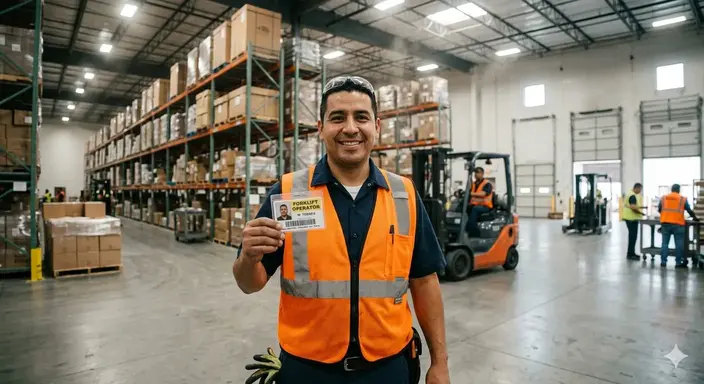
  • A forklift license card
  • A certificate
  • Paperwork proving you’re trained

Employers need these documents for their OSHA records. That’s it. No long government lines. No exams like the DMV. It's straightforward.

Now the big question:

Where Can You Go to Get Your Forklift License?

One of the most common questions we get is: “Where do I actually get forklift certified?”
Honestly, it sounds overwhelming at first, but it doesn’t have to be. Getting certified usually takes less than a day, and the cost is pretty reasonable.

To make things easier, here are the three main ways you can take your forklift training:

1. Attend a Course at a Training School

If you’re not currently employed or you’ve never operated a forklift before, this is your best option.

Training schools are designed to teach you how to operate a forklift safely and properly. Just remember:
👉 Pick a course that matches the exact type of forklift you want to learn.
Each forklift type has different controls and safety requirements, so the training has to match the equipment.

A typical course includes:

  • Classroom lessons (PowerPoint, videos, safety discussions)
  • Hands-on driving practice
  • A written test
  • A practical driving test

If you don’t pass the tests the first time—don’t panic—you can retake them.

Why choose a training school?

Reason #1: You're a beginner who wants a job.
You take the class, pass the tests, and once the instructor signs off, you get your certificate and operator card. These are what you show employers when applying for forklift jobs.

We even have a directory of training schools on this site. Reach out to them, ask about prices, schedules, duration, requirements, and—if needed—whether they offer job placement assistance.

Reason #2: Your company doesn’t have training resources.
Some employers don’t have a qualified trainer or the facility to run safety training. In that case, they send you to a school.
The downside? You might be away from work for a day or two—and in some cases, you may not get paid while attending.

2. Taking an Online Certification

Some private companies offer online forklift certification.
All you need is an internet connection and a bit of free time. You can take the course anytime, anywhere.

It’s super convenient, especially for busy people.

However, keep in mind:

👉 Online training covers the classroom part only.
You still need hands-on evaluation later, because OSHA requires practical training.

If you’re considering online learning, make sure the school offers a legitimate certification.

3. Participating in Employer-Sponsored Training

If you're already working, your employer is actually responsible for providing forklift training. OSHA requires it—and they do surprise inspections. Companies that fail to train workers properly can get fined thousands of dollars, and in serious cases, even face criminal charges.

The nice thing about employer-provided training (also called on-site training) is that the trainer can customize the course to your actual workplace, including:

  • The forklifts you use
  • Your work environment
  • The company’s safety rules
  • The common hazards in your facility

Workers also get to discuss real issues with their supervisors during training, which helps improve safety overall.

4. Online Forklift Certification (Classroom Portion Only)

If you’re tight on time or budget, you can take the online theory training first. It covers:

  • OSHA rules
  • Basic safety
  • Equipment types
  • Load handling basics
  • Hazard awareness

But here’s the catch:
OSHA still requires a hands-on evaluation.

So online certification is only half of the process — but it’s convenient. After completing the online class, you take your paperwork to a training provider or employer for the final evaluation.

Best for:

  • People who need certification ASAP
  • Anyone renewing their forklift license
  • Employers certifying multiple workers

5. Union Training Centers

If you’re part of a construction or manufacturing union (or planning to join one), they often provide forklift training through:

  • Apprenticeship programs
  • Safety training centers
  • Skills upgrade courses

This option is highly respected and usually free for members.


Training OptionWhat It IncludesBest ForProsCons
1. Attend a Course at a Training School - Classroom lessons (slides, videos, safety topics)
- Hands-on forklift driving practice
- Written test
- Practical driving test
- Certificate + operator card upon passing
- Beginners
- Job seekers
- Workers whose company has no trainer
- Full hands-on experience
- Instructor guidance
- Certification issued same day
- Job placement assistance sometimes available
- May require travel
- Usually 1–2 days off work
- Some employers don’t pay for training time
2. Taking an Online Certification - Online classroom portion
- OSHA safety rules
- Equipment basics
- Hazard recognition
- Convenient, self-paced modules
- Busy individuals
- Anyone wanting quick theory training
- People who prefer online learning
- Very convenient
- Low cost
- Can study anytime, anywhere
- Covers theory only
- Needs separate hands-on evaluation
- Must verify if program is legitimate
3. Employer-Sponsored On-Site Training - Training on real workplace forklifts
- Site-specific hazard training
- OSHA-required evaluations
- Interaction with supervisors for real issues
- Current employees
- Newly hired workers
- Employers certifying staff
- Usually free
- No travel needed
- OSHA prefers site-specific training
- Highly relevant to actual job tasks
- Only available if employer offers it
- Certification may not transfer jobs
4. Online Forklift Certification (Classroom Portion Only) - OSHA theory training
- Equipment types
- Basic load handling
- Hazard awareness
- Must complete hands-on evaluation separately
- People needing certification fast
- Renewals
- Employers training groups
- Fast and flexible
- Suitable for renewals
- Low-cost option
- Not a full certification
- Still needs in-person skills test
5. Union Training Centers - Apprenticeship programs
- Skills upgrade courses
- Safety center training
- Forklift certification included in some unions
- Union members
- Construction & manufacturing workers
- People planning to join a union
- Often free for members
- Highly respected training
- Strong career support
- Must be a union member
- Limited availability depending on location


You can read this guide to help you choose the training school: How to Choose the Best Forklift Training School?

Here are some more articles that could help you:

Cost Comparison Table for Forklift Training Options

Training OptionTypical Cost (Per Person)What’s IncludedCost Considerations / Trade-offs
1. Attend a Course at a Training School $150 – $300 - Classroom lessons & hands-on driving
- Written test & practical test
- Certificate + operator card issued same day
- May require travel
- Time off work may be unpaid
- Most complete training option
2. Community Colleges / Vocational Schools $150 – $300 (varies by school) - Classroom instruction
- Hands-on training
- OSHA & warehouse operations courses
- Career pathway support
- Longer training time (several days to a week)
- Recognized and reputable programs
3. Employer-Sponsored On-Site Training Usually FREE (employer pays) - Site-specific training
- Uses actual workplace forklifts
- OSHA-required evaluation included
- Only available if employer offers it
- Certification may be non-transferable
4. Online Certification (Classroom Portion Only) $39 – $100 - OSHA theory training
- Safety rules, equipment types
- Hazard awareness modules
- Self-paced learning
- MUST still complete hands-on evaluation
- Not a full certification by itself
5. Union Training Centers Free or Low-Cost for members - Apprenticeship programs
- Skills upgrade courses
- Safety training center instruction
- Requires union membership
- Limited availability or scheduling


What to Look for in a Good Training Provider

There are tons of forklift training companies out there — some excellent, some… not so much. If you want real, job-ready training (and not just a paper card), here’s what you should always look for:

1. They Must Follow OSHA 1910.178 Standards

This is the big one.

If the course doesn’t follow OSHA’s powered industrial truck standard (1910.178), then whatever “license” they give you won’t hold up in the real world. Employers can’t accept it, OSHA won’t acknowledge it, and you’ll just waste your time and money.

A legitimate training provider should clearly state:

✔ Their program is OSHA-compliant
✔ They teach both classroom (theory) and hands-on (practical)
✔ They conduct written exams and practical evaluations

If you don’t see OSHA mentioned anywhere, that’s a huge red flag.

2. They Provide REAL Hands-On Driving Practice

A proper forklift course isn’t just sitting in a classroom and watching videos. You need to touch the machine, drive it, practice maneuvering, lifting, turning, and parking — because that’s what you’ll do on the job.

Unfortunately, there are some fly-by-night “schools” that:

  • Rush through the class
  • Put you on a forklift for 2 minutes
  • Hand you a certification card without real training

Avoid these at all costs.

A good school will give you enough time behind the controls so you feel confident and safe.

3. Their Equipment Should Be Updated and Well-Maintained

Take a quick look at their forklifts:

  • Are they in good condition?
  • Do they look safe?
  • Are the training yards clean and organized?

If their machines look like they came from a scrapyard, imagine what the training will be like.

A respectable provider takes pride in their equipment because it's a reflection of how seriously they take safety — and your training.

4. They Let You Train on Multiple Forklift Types

If you can get certified on more than one forklift in the same visit, that’s a huge advantage. Why?

More machine types = more job opportunities.

Ask if they can train/certify you on:

  • Counterbalance forklifts
  • Reach trucks
  • Order pickers
  • Pallet jacks (walkie/rider)
  • Narrow aisle trucks
  • Rough terrain forklifts

The more skills you walk away with, the more attractive you are to employers.

5. They Provide All Proper Documentation After Training

A legit training school will give you the complete set of documents you need:

Forklift operator certificate
Wallet-sized operator card
Written test results
Practical evaluation form

Employers need these documents to prove you were properly trained. If a provider only gives you a “card” but no certificate or evaluation sheet, that’s not enough.

You should leave the training with everything required — no missing pieces.

For Employers: You Can Appoint Someone as an In-House Trainer

OSHA’s rule (1910.178(l)(2)(iii)) basically says that forklift training must be done by someone who has the knowledge, training, and experience to teach operators and properly evaluate them.

The good news?
OSHA doesn’t list strict qualifications or require special licenses for trainers. That means you can choose someone from your own team — as long as they know forklifts, understand safety, and are capable of teaching others. Many companies pick their most experienced operator or supervisor to become the in-house trainer.

To make the job easier, you’ll need a few training materials, like:

  • Training videos
  • Presentation slides
  • Evaluation forms
  • Certification cards or templates

Once your in-house trainer is set up, your company can handle all future certifications internally — saving time and money. 

What Type of Forklift License Do You Need?

Most people think there’s just one forklift license — but that’s not how it works. Forklifts come in different classes, they operate differently, and OSHA requires you to be trained and certified on the specific type of truck you’ll actually use on the job. That means your certification for one machine does not automatically cover you for all the others.

Here’s a breakdown of the most common types:

1. Sit-Down Counterbalance Forklift

This is the “classic” warehouse forklift everyone recognizes — the one with the big counterweight in the back.
It’s used for loading trucks, stacking pallets, and general warehouse work.
If you’re brand new, this is usually the first certification you’ll get.

2. Reach Truck

Designed for narrow aisles and tall racking systems.
The forks extend forward (“reach”) to pick loads deep in shelves.
Most modern warehouses, especially e-commerce facilities, rely heavily on reach trucks.

3. Order Picker (Stock Picker)

This one lifts you along with the forks — you literally rise up to grab items from shelves.
Because your feet leave the ground, fall protection is required.
These are commonly used in fulfillment centers and distribution hubs.

4. Electric Pallet Jack / Walkie Rider

Small but mighty. These are used nonstop in warehouses for moving pallets quickly.
Even though they look simple, OSHA still requires training because they can cause serious injuries when misused (especially the rider version).

5. Rough Terrain Forklift (Telehandler / Construction Forklift)

Built for dirt, gravel, mud, and uneven outdoor conditions.
Used on construction sites, lumber yards, farms, and industrial projects.
Totally different controls and physics compared to warehouse forklifts.

Which Certifications Do Employers Want the Most?

If you’re trying to get hired, the biggest demand is for operators certified on:

  • Sit-down forklift
  • Reach truck
  • Order picker

These three machines cover the bulk of warehouse and logistics operations. Having all three on your resume makes you stand out immediately — employers love versatile operators.

Some training schools even offer combo packages where you can get certified on multiple machines in one day.

What Are the Requirements According to OSHA? 

If you want to get a legit forklift “license” (what OSHA actually calls operator certification), you need to follow the training process laid out in OSHA Standard 29 CFR 1910.178(l). OSHA doesn’t issue the license themselves — but they do tell employers exactly how training must be done.

Here’s how it works in real life:

1. You Must Complete All Three Parts of OSHA-Required Training

OSHA says forklift training must include three components:

  1. Formal instruction
    – This is your “classroom” training.
    – It can be done in person or online.
    – It covers safety rules, forklift controls, stability, load handling, and workplace hazards.
  2. Practical (hands-on) training
    – You actually get on a forklift and practice driving.
    – A qualified trainer must demonstrate proper operation first.
    – You practice starting, stopping, lifting, stacking, turning, parking, and more.
  3. Evaluation of your performance
    – A trainer must watch you operate the forklift and evaluate your skills.
    – This is where they check if you're safe and competent to operate in real-world conditions.

OSHA requires that all three steps must be completed before a person is considered “trained and certified.”

2. What the Training Covers (Based on OSHA Topics)

OSHA lists specific topics that must be included in the training. It’s not just about “how to drive.” Training must cover:

  • How to start, stop, steer, and maneuver the forklift
  • How to raise, lower, and control loads
  • Forklift stability (center of gravity, tip-over prevention)
  • Pre-operation inspections
  • Refueling or battery charging
  • Safe load handling
  • Hazard recognition in the workplace
  • Differences between forklifts and cars (yes, OSHA literally says this)
  • Operating on ramps, docks, and tight aisles
  • Pedestrian safety and visibility
  • Parking and securing the forklift
  • Any unique hazards in the trainee’s workplace

So even though forklift driving looks simple, OSHA wants operators to understand both the machine and the environment they’ll be using it in.

3. Written Test + Practical Test

After the training portion, OSHA requires:

  • A written test (to prove you understand the rules), and
  • A performance evaluation (to prove you can drive safely)

You must pass both to be certified.

4. What You Receive After Passing

Once you finish training and pass the tests, you’ll be issued:

  • A Forklift Operator Certificate
  • A Wallet Operator Card

These documents are what most people call a “forklift license."

They show:

  • Your name
  • The type(s) of forklift you’re certified to operate
  • Training provider or employer
  • Date of training
  • Name/signature of the evaluator

Employers are required by OSHA to keep this documentation on record.

5. OSHA Requires Renewal Every 3 Years

Your forklift certification isn’t valid forever. OSHA says operators must be re-evaluated every three years, or sooner if:

  • They’re involved in an accident or near-miss
  • They’re observed operating unsafely
  • They’re assigned to a different type of forklift
  • Workplace conditions change significantly

Here is a video that explains the requirements, contents of the course, different characteristics of forklifts, safety precautions, OSHA regulations, etc:


How Can I Prepare for the Forklift License Exam? 

Getting ready for your forklift certification test doesn’t have to be stressful. With the right prep, you can walk into both the written exam and the hands-on evaluation feeling confident. Here’s a simple, practical breakdown of how to prepare — based on real OSHA requirements and what trainers actually expect.

1. Know What OSHA Requires You to Learn

OSHA’s forklift certification isn’t just about “driving.” The written test covers safety rules, machine controls, and workplace hazards based on OSHA 29 CFR 1910.178(l). Before your exam, make sure you're familiar with:

  • Forklift parts and controls
  • How to start, stop, steer, and maneuver
  • Load handling and stability triangle
  • Pre-operation inspections
  • Refueling/charging procedures
  • Pedestrian safety
  • Operating on ramps and uneven surfaces
  • Parking and securing the forklift

Most training schools give you study materials, but you can also review free OSHA guides online.

2. Get Comfortable with the Equipment (Hands-On Practice)

For the practical exam, you’ll need to show that you can safely operate a forklift. You don’t have to be perfect — but you do need to be safe, smooth, and in control.

To prepare:

  • Take a formal training class with hands-on driving
  • Practice basic maneuvers like turning, reversing, lifting, and parking
  • Learn to keep loads low while traveling
  • Practice looking over your shoulder during reverse
  • Get used to slow, controlled driving (trainers hate fast operators)

The more comfortable you are with the forklift before testing day, the easier it will be to pass the evaluation.

3. Study Using Practice Quizzes and Review Sheets

Most reputable training providers include:

  • Sample written exams
  • Flashcards
  • Safety videos
  • Review sheets

These are extremely helpful because the actual OSHA-style test covers the same topics. Spending even 20–30 minutes reviewing practice questions can dramatically improve your score.

TIP:
If you don’t understand a topic — like the stability triangle or load center — ask your trainer. They expect questions.

4. Learn the Common Mistakes That Make Trainees Fail

During the practical driving test, most failures happen because of avoidable mistakes. Here are the big ones to avoid:

  • Driving too fast
  • Not looking in the direction of travel
  • Lifting the load too high while moving
  • Forgetting to set the parking brake
  • Improper turns (especially sharp turns with a load)
  • Not performing pre-operation inspection properly

If you practice these habits beforehand, passing becomes much easier.

5. Understand That the “Forklift License” Is Really a PIT Certification

Forklift licensing is officially called Powered Industrial Truck (PIT) training by OSHA. To get certified, you must:

  1. Complete formal instruction
  2. Complete hands-on practical training
  3. Pass a written test
  4. Pass a performance evaluation

Both the written exam and the driving test are mandatory. Your certification is only valid once you pass both portions.

6. Why Preparing Ahead Helps You Pass on the First Try

Studying the material and getting comfortable with the forklift reduces nerves and prevents simple mistakes during the evaluation. When you know what the trainer is looking for — safe speed, control, awareness — the test becomes straightforward.

Most people who prepare even a little pass without any issues.

FAQs (Because Everyone Asks These)

Do forklift licenses expire?

Yes — you must be re-evaluated every 3 years per OSHA.

Can I get my forklift license online only?

No. Online covers the classroom portion only. You still need hands-on training.

Is my license valid in all states?

Yes — OSHA is federal, not state-specific.

How soon can I work after getting certified?

Immediately, as long as the equipment matches your training.

Final Thoughts: Getting Your Forklift License Is Easier Than You Think

A lot of people get intimidated when they hear “forklift certification,” but honestly, the process is way simpler than most expect. Whether you choose a local training school, a community college, your employer’s on-site program, or even start with an online course, getting certified is quick, straightforward, and usually very affordable. Most people finish their training in a single day.

And here’s the best part:

Once that license is in your wallet, everything changes. You instantly become more employable in warehouses, logistics companies, retail distribution centers, shipping yards, manufacturing plants, and construction sites. Forklift operators are always in demand — and certified operators often earn better pay, get more job security, and enjoy more opportunities for promotion.

So if you’ve been thinking about it, go for it. The training is short, the investment is small, and the doors it opens are huge.


{source}

{/source}


Get Certified Fast
Take Forklift Training Online

Get Started Here

Get Your Forklift Certificate Today


Search Site