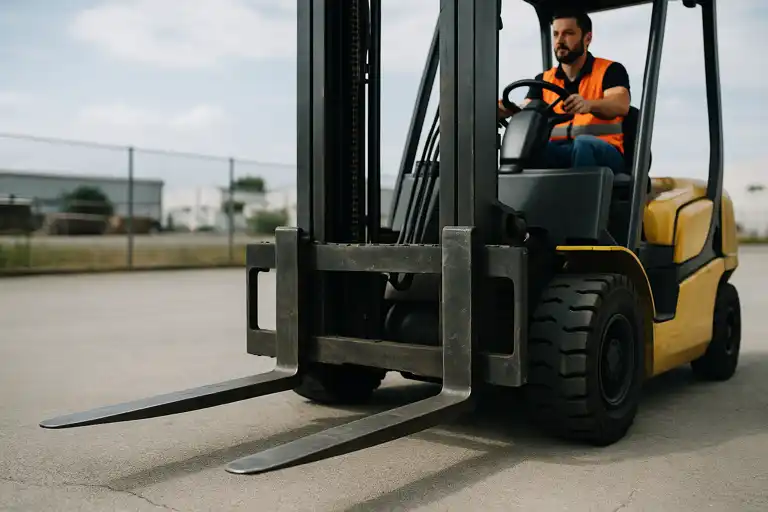
When you're driving a forklift with no load, the forks should ride low — about 4 to 6 inches off the ground.
Most trainers say “keep it low, keep it safe.”
Think of it like holding a pizza box:
Just high enough so it doesn’t scrape the floor, but low enough so you’re not blocking anyone’s view or hitting random stuff lying around.
Keeping the forks low helps you:
- avoid clipping pallet corners
- avoid tripping anyone walking nearby
- stay stable while driving
Basically, you're just cruising with the forks skimming comfortably above the ground — not dragging, not floating.
Driving on a Slope
Forklift rules on slopes are a bit different, because your stability shifts. The height still stays low, but the orientation of the load matters a lot more.
Going Uphill
- Always keep the load uphill from you.
- If the load is in front, keep the forks low (again, around 4–6 inches).
- Tilt the mast back enough to secure the load, but not excessively.
- The goal: stop the load from sliding but keep the machine stable.
Going Downhill
- Again, keep the load uphill from you.
(Meaning: if downhill, you usually drive in reverse so the load stays on the uphill side.) - Forks stay low — same 4–6 inch rule.
- Slight backward tilt to keep the load from shifting.
Important: OSHA doesn’t specify an exact “inches” requirement, but nearly all training manuals and state safety guides recommend 4–6 inches.
6–8 inches is sometimes quoted, but 4–6 inches is the widely accepted best practice.
Parking the Forklift
When it's time to park:
- Lower the forks completely to the ground — no gap.
- Tilt the mast forward until the forks rest flat.
- This prevents trip hazards and keeps the forklift stable.
Parking rules also include:
- Set the parking brake
- Neutral
- Turn off the engine
- Remove the key (if unattended)
Quick Accuracy Check (Based on OSHA + ITA Standards)
Here’s what’s actually required or recommended:
✔ OSHA: Keep forks as low as possible while traveling
✔ OSHA: Keep load uphill on slopes
✔ OSHA: When parked, fully lower forks to the floor
✔ Industry Standards (ITA, RTOs, forklift training schools):
→ Fork height while traveling is “4–6 inches above ground”
→ Slight back tilt when carrying a load
→ Reverse downhill when vision is blocked
So the corrected safe traveling height is 4–6 inches, not 6–8.
Everything else you described matches standard forklift safety practices.
Ready to Rev Up Your Career With Forklift Certification?
Get Certified Online & Be Job-Ready Today! It's Fast & Easy!
With our online course, getting certified is as easy as clicking, learning, and succeeding.
Don't let another day go by without taking the next step in your career.
Why 4–6 Inches Is the “Magic Number”
1. It prevents tip-overs
Forklifts are surprisingly easy to tip if your center of gravity is messed up.
When the forks—and the load—are carried too high, all the weight shifts upward. This makes the whole machine top-heavy. A sharp turn, sudden stop, or small pothole can get you into trouble fast.
Keeping the forks low keeps the weight low. Simple and safe.
2. It protects the floor (and your forks)
Warehouse floors aren’t perfectly smooth. There are expansion joints, small dips, uneven surfaces, and sometimes cracks.
If your forks are too low, they’ll hit the ground, drag, or get stuck. Hitting something at 5 km/h with a steel fork feels like slamming into a wall.
3. It gives you better visibility
Driving with the forks up in the air blocks your view—especially if there’s a load on them.
Low forks mean you can actually see where you’re going. Shocking concept, right?
4. It keeps pedestrians safe
People walking around forklifts already face risks. High forks are hidden hazards waiting to poke someone’s thigh or stomach.
Low forks = fewer surprises and fewer injuries.
What OSHA Says (and Why They Don’t Give an Exact Number)
Here’s something that confuses a lot of operators:
OSHA does NOT specify a measurement like “4–6 inches.”
Instead, OSHA says the forklift must be operated in a “safe traveling position,” and that includes keeping the load:
- Low
- Stable
- Tilted back slightly
So while OSHA doesn’t give an exact number, every trainer, examiner, and safety manager interprets that as keep forks just above the ground, not chest-high, not knee-high—just low.
This is why training schools and employers typically stick to 4–6 inches. It meets OSHA’s expectations and keeps operators safe.
Recommended Fork Height Based on Situation
| Situation | Recommended Fork Height | Reason |
|---|---|---|
| Traveling with no load | 4–6 inches (or 6–8 inches depending on guideline) | Prevents hitting floor obstacles, improves stability |
| Traveling with a load | 4–6 inches off the ground, mast slightly tilted back | Keeps load stable and secure |
| Approaching a pallet | Forks level with the pallet opening | Smooth entry into pallet |
| Lifting a load | Adjust height based on pallet | Safe engagement before lifting |
| Parking the forklift | Forks flat on the ground | Prevent trip hazards and accidents |
Driving With a Load vs. Without a Load: What’s the Difference?
The ideal fork height changes slightly depending on whether you’re carrying something or not. Here’s a quick breakdown:
✔ With a Load
When you have a pallet or product on your forks:
- Keep the forks 4–6 inches off the ground.
- Tilt the mast back to stabilize the load.
- Do not lift the load higher than needed while traveling.
That little backward tilt is key—it's what keeps the load from sliding or falling forward when you brake.
✔ Without a Load
If your forks are empty:
- Lower them as low as safely possible.
- For long distances, keep them 3–4 inches above the floor so they don't drag.
- Never, ever drive with empty forks raised high.
High empty forks are just as dangerous—maybe even more—because people don’t expect them at eye level.
| Source / Standard | Recommended Fork Height While Traveling |
|---|---|
| OSHA (general practice) | Keep forks low for clear travel (no exact number) |
| Workplace safety trainers | 4–6 inches above the ground |
| Many training schools | 6–8 inches above the ground |
| Manufacturer guidance | Keep forks low and tilted back when loaded |
Fork Height and Stability (Explained Simply)
Okay, here’s forklift science in the simplest way possible:
Think of your forklift like one of those claw machines in the arcade.
When the claw goes high, it wobbles. When the claw is low, it’s stable.
Your forklift works exactly the same.
When the forks are up:
- Your center of gravity rises
- You become more likely to tip over
- Braking becomes less stable
- Turning becomes riskier
You don’t need a physics degree for this—experience teaches it quickly.
Every forklift has a stability triangle. When your load goes too high, the center of gravity can move outside that triangle. Once that happens, the forklift can’t save itself—it will tip.
Fork Height on Ramps, Docks, and Uneven Surfaces
Sometimes you’re not on a smooth warehouse floor. You might be on:
- A loading dock
- A ramp
- A driveway
- Rough concrete
In these spots, is 4–6 inches still okay?
Yes—but you may need to slightly adjust.
Here are the real-world tips:
- On a ramp, point forks uphill if possible.
- Keep forks just high enough to avoid scraping the slope.
- Do not lift the load higher “just to be safe”—that actually makes it worse.
- Move slowly and avoid sharp turns.
The key is keeping the center of gravity low and the forks just clear of obstacles.
Common Mistakes Operators Make With Fork Height
Even experienced operators mess this up sometimes. Here are the most common fork height mistakes:
1. Driving with forks chest-high
This is a huge red flag. It blocks vision and spikes tip-over risk.
You’ll see this mistake a lot with new operators who forget to lower forks after picking up a load.
2. Forgetting to lower forks after unloading
You drop the pallet… and boom, you drive off with forks at waist height.
Make it a habit:
Lower, tilt neutral, go.
3. Dragging forks on the ground
Dragging the forks:
- Damages floors
- Damages forks
- Reduces control
- Makes awful screeching noises
No one wants to be “that operator.”
4. Raising forks while turning
Turning + raised forks = prime tip-over conditions.
5. Assuming “higher = safer” on uneven ground
The opposite is true. High forks make you unstable. If you're dealing with bumps or dips, go slower, don’t go higher.
Real-Life Scenarios: What Height Should Forks Be?
Let’s walk through a few warehouse situations so you can picture it clearly:
Scenario 1: Driving Across the Warehouse
Keep forks 4–6 inches high. Load tilted back. Move at a safe speed.
Scenario 2: Tight Aisles
Low forks help you avoid hitting racks and keep visibility clear.
Remember: turning radius changes when your forks are raised.
Scenario 3: Carrying a Tall Load
If the load blocks your view:
- Drive in reverse
- Keep forks low
- Go slow
Never raise the forks “just to see better.” That’s asking for an accident.
Scenario 4: Crossing Expansion Joints
If the floor has bumps or cracks:
- Keep forks slightly higher than usual
- Still stay under 8 inches
- Slow down to prevent load shifting
Scenario 5: Going Down a Ramp
Load should face uphill.
Keep forks low.
Don’t power down the ramp—it’s too risky.
When Parking the Forklift: Forks Go All the Way Down
When you’re done driving or stepping off:
- Lower forks completely to the ground
- Shift to neutral
- Set the brake
- Turn off the key
Raised forks on a parked forklift are a major hazard. Someone can trip over them, walk into them, or hit them with another machine.
A good habit:
Don’t leave the seat unless the forks are fully down.
When You’re Carrying a Load, It’s Good Practice To:
When you’re driving with a load, always tilt the mast back a little. This keeps the load pressed against the backrest so it stays steady while you move. Tilting back also shifts the center of gravity toward the rear, which makes the forklift a lot more stable on the go.
Make sure the load is balanced properly. If it’s off-center, the forklift can tip over—seriously. Put the heaviest part of the load closest to the front wheels, and never go beyond what the data plate says your forklift can handle.
If the load blocks your view in front, don’t guess what’s ahead—drive in reverse. And when backing up, don’t rely only on the mirrors; actually turn your head and look where you’re going.
Stay aware of your surroundings, especially the height of the mast and overhead guard. Low doors, beams, and warehouse entrances can surprise you if you’re not paying attention.
Again—never overload the forklift. Going past the max capacity is one of the top causes of tip-overs, and tip-overs are a major cause of fatal and serious injuries. Always double-check the truck’s load limit before lifting anything heavy.
Stick to the speed limits in your workplace. Most areas allow up to 8 mph, but if there are lots of pedestrians or tight spaces, it can drop to around 3 mph. If you’re not sure, ask your safety supervisor what the speed limit is where you work.
And most importantly—don’t operate a forklift unless you’re properly trained and certified. If you’re not trained, you shouldn’t be behind the controls. Safety first, every time.
Frequently Asked Questions (SEO Boosters)
1. Can I drive with the forks fully lowered?
Not completely. Fully lowered forks can scrape or catch on the floor. Keep them just above ground level.
2. Should I tilt back when traveling with a load?
Yes, always. The slight backward tilt keeps the load stable and prevents forward spills.
3. Should the forks be level when traveling?
They should be slightly tilted back with a load.
If the forks are empty, keep them level and low.
4. Does fork height change for reach trucks?
Reach trucks operate differently, but the rule still applies:
Travel with the load lowered unless stacking/unstacking.
5. What about order pickers?
Different story. With order pickers, you go up with the forks. Fall protection is required. Fork height rules differ because you're basically riding a platform.
Why This Fork Height Rule Matters So Much
If there’s one safety habit you engrave into your brain as a forklift operator, let it be this one:
Keep the forks low when traveling.
It’s simple, yet it prevents:
- Tip-overs
- Spilled loads
- Pedestrian injuries
- Fork damage
- Reduced visibility hazards
Most accidents with forklifts trace back to a few bad habits—and driving with elevated forks is one of the biggest.
Final Thoughts: Keep It Low, Keep It Safe
Operating a forklift isn’t complicated once you understand the basics. And fork height is one of the basics you’ll use every single day.
Just remember the golden rule:
👉 4–6 inches above the ground. Always.
👉 Tilt back with a load.
👉 Lower completely when parking.
Follow that, and you’ll already be safer than half the operators out there.