So you've Googled "where can I go to get my forklift license," and you've probably already noticed the annoying part: every article says the exact same thing. Go to a school. Take it online. Ask your boss. Five neat little options, and not one of them tells you what actually works when you're sitting across from a hiring manager.
Let me give you a straighter answer, because I've been on every side of this thing.
Back in 2010 I was a brand-new operator. My employer shipped me off to a third-party training provider to get certified, and I spent the next two years on the machines. After that, they made me their in-house safety trainer. I took a proper train-the-trainer course and spent five more years certifying and evaluating operators myself. So I've been the nervous trainee, the working operator, and the guy who decides whether you're safe to drive. That changes how I'd answer this question completely.
Here's the short version: there's no government office that hands out forklift licenses. What everyone calls a "forklift license" is really an OSHA operator certification — and where you go depends entirely on the job you're after. Let me walk you through why, and exactly where I'd send you.
First, Get This Straight: Who Actually Certifies You
Almost nobody explains this part, and it trips up thousands of people every year.
The final say on your certification doesn't come from a school. It comes from the employer, through their designated representative. OSHA's standard (29 CFR 1910.178(l)) says the person evaluating and signing off on you has to have the knowledge, training, and experience to do it — and out in the real world, that lands on the employer.
So here's the kicker: even if your uncle's run forklifts for 30 years and owns his own warehouse, him "training" you on a Saturday afternoon doesn't make you certified for a job somewhere else. And a card you bought online by itself? That doesn't make you a certified operator either.
Why does this matter for where you go? Because the certification has two halves:
- The classroom part — the theory (OSHA rules, stability, load handling, hazards). This can be done online.
- The hands-on part — actually driving the machine and getting evaluated. This has to happen on a real forklift, in a real work environment.
Once that clicks, the whole "where do I go" question gets a lot simpler.
The Path I Actually Tell People to Take
Employers today want to cut corners. They'd rather hire someone who already knows the basics than train a total blank slate from zero. So here's the route I point people toward — and it's the one that's gotten my trainees hired.
Step one: knock out the classroom portion through an online course. It proves to an employer that you already get the safety fundamentals and the OSHA material. It's fast, it's cheap, and you can do it tonight from your couch.
Step two: when you apply, tell them you've finished the theory and you're ready to be trained on the practical side and evaluated in-house. That's the magic sentence right there. You're showing initiative and you're letting them certify you on their machine, in their environment — exactly the way OSHA wants it.
Why does this work so well? Because the practical evaluation should always happen on the actual forklift you'll be running, in the actual workplace — real floor surfaces, real traffic, real hazards, and the real behavior of the people working around you. A certificate earned in some spotless training yard on a totally different machine doesn't prove you can handle a busy dock at your job.
What About Third-Party Training Providers?
I've got nothing against third-party training — it's how I got my own start. But if you're going that route, here's my advice: go through a staffing agency.
Two reasons. One, a good staffing agency can talk to the employer and get you trained on the employer's forklift, in the employer's environment. Two, they've got the connections to actually place you afterward, which is the entire point.
What I'd steer clear of is walking into some random equipment rental company or training mill that promises a license "good for any forklift, any environment." That promise is exactly where people throw their money away. More on that in a minute.
Two Real Stories That Show What's on the Line
The Pennsylvania kid who kept getting turned down. I knew a 20-year-old working as a warehouse associate at an Amazon facility through a staffing agency. He watched forklifts move maybe 90% of the freight in that building and knew that's where he wanted to be. The problem? Before that associate gig, he'd gone to three interviews and every single one asked him the same thing: "Do you already have your forklift certification?" Every time he said no, and every time it felt like a dealbreaker. Three rejections. Finally he signed up for a real training course, got certified, walked back into the staffing agency — and got accepted. That certification was the only thing standing between him and the job he wanted.
The Ohio operator who cost his boss a fortune. Another guy worked at a logistics warehouse in Ohio for three years. When they hired him, the employer never even checked his qualifications — he just handed over his credentials, including a copy of his forklift cert card, and got to work. Three years later, an OSHA inspector shows up and audits every operator on the floor. Turns out his card only certified him for a three-wheel counterbalance truck — but he'd been running an order picker the whole time. On top of that, he'd never done his refresher training. The employer got fined $5,000 for every violation their operators racked up.
That second one is the story I really want you to remember, because the cards aren't just paperwork. The type of machine on your card is everything.
The Most Common Mistake I See
The biggest "where do I go" blunder is people rushing off to a generic third-party provider — usually an equipment rental outfit — that swears their license will work for any forklift, any environment. Then they show up to a job and the card gets rejected because it doesn't match what the position actually needs.
Here's the smarter way to do it:
- Read the job qualifications first. Find out the exact type of forklift the position needs.
- Then find a provider who delivers that exact training. Counterbalance, reach truck, order picker — match the training to the role.
That targeted training only takes a day or two, so you'll still have plenty of time to apply when a posting pops up. Don't get certified in a vacuum and just hope it fits — figure out what the job needs, then go get that.
How to Spot a Scam or "Paper Mill"
A worthless card looks totally legit right up until an OSHA inspector picks it up. Here are the red flags I've run into personally:
- No trainer's name and no training date on the card. If those are missing, an inspector can write up you or your employer.
- No forklift type listed. You might assume your card covers everything — but if a job needs a three-wheel counterbalance and your card doesn't spell that out, it can get rejected on the spot.
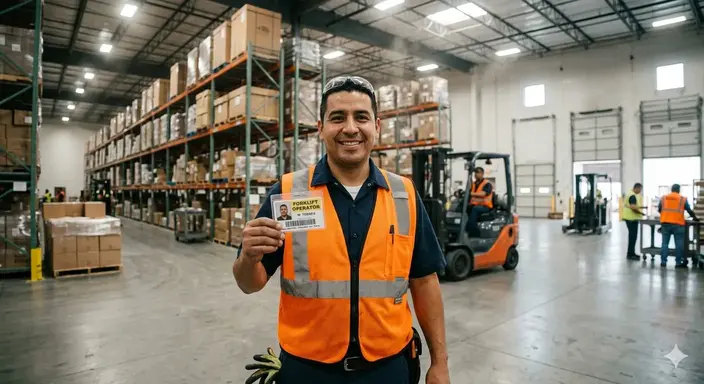
A real certification names the evaluator, the date, and the specific equipment you're cleared on. If yours doesn't, it's not protecting you.
What It Really Costs (Including the Fees Nobody Warns You About)
The advertised price rarely tells the whole story. Keep an eye out for these:
- The card and certificate as add-ons. Some providers quote you the training price, then charge extra for the actual operator card and certificate. Ask up front.
- Retest fees. Fail and want another shot? Some providers charge up to double the original training cost for a retake.
- Combo pricing. Want to get certified on two or more machine types? Combo packages are genuinely a great deal — and being certified on multiple machines makes you way more hireable.
- The hidden cost of "free" employer training. When your employer foots the bill, that's great — but you might not get paid for the hours you're away from your regular work. "Free" isn't always free.
Going the Online Route the Right Way
If you take the classroom portion online, do it through a provider whose program follows the proper standards. One I'd point people to is forklifttraining.com — their training is built around OSHA, ANSI, and CSA standards (that CSA bit matters for my Canadian readers).
Look for one more thing: an online registry on the provider's site where an employer can verify your credentials. That kind of verification builds instant trust with a hiring manager.
And don't forget the non-negotiable: the hands-on portion has to happen at the actual worksite, on the actual forklift you'll run, under the actual conditions — the surface, the traffic, the hazards. Online gets you halfway. The job site finishes it.
What Employers Actually Accept (And Why Cards Don't Always Transfer)
When you apply, employers want proof of training and experience — usually previous training certificates plus employment certificates showing you've actually done the work.
But here's something that surprises people: a certificate from one employer doesn't automatically carry over to the next. Say School A trained you on a four-wheel counterbalance, but Employer B runs three-wheel machines. Those are different enough that B won't just take your old card — they'll re-evaluate you on their equipment. That's not them being difficult; it's them staying compliant. So expect a re-evaluation when you switch jobs or switch machines, and don't read it as a sign your original training was junk.
Quick Answers to the Stuff Everyone Asks
Do forklift licenses expire? Yep. OSHA wants you re-evaluated every three years — or sooner if you have an accident or near-miss, get caught operating unsafely, switch machines, or your workplace changes a lot.
Can I get certified completely online? Nope. Online only covers the classroom theory. The hands-on training and evaluation have to be done in person, on a real machine.
Is my certification good in every state? OSHA is federal, so the standard's the same nationwide — but since the cert is tied to the employer and the specific equipment, a new job will usually re-evaluate you anyway.
How soon can I work after certifying? As soon as your evaluation is signed off and the equipment matches your training.
So — Where Should You Go?
If I had to boil it down to one breath: knock out the classroom theory online, find out exactly what machine your target job needs, and get your hands-on evaluation done on that employer's equipment — ideally placed through a staffing agency that can set it up. That's the path that survives an OSHA audit, makes a hiring manager happy, and doesn't leave you holding a card that gets bounced at the door.
The training's short. The cost is small. And once the right certification is in your wallet, the warehouses, distribution centers, and logistics yards open up fast. Just make sure that card has your trainer's name, the date, and the right machine on it — because in this trade, that little card is the whole job.