 If you're trying to figure out how to become forklift certified, you're in the right place—and you're hearing it from someone who's lived every side of it.
I started out as a forklift operator back in 2010, the same way most people do: an employer handed me a job, sent me to a training provider, and put me on the equipment until I could actually move a load without breaking a sweat.
Thirteen years later, I became a trainer. I've since trained hundreds of operators in forklift safety and certification across construction sites, warehouses, and logistics yards in several states and abroad.
So when I tell you how forklift certification really works, it's not from a brochure.
It's from the floor, the laydown yard, and a lot of evaluations. Here's the honest version.
First, Kill the "Forklift License" Myth
People ask me all the time how to get their "forklift license." There's no such thing. No DMV booth, no state card, no federal permit that follows you around the country.
What you're actually earning is certification — documented proof that you've been trained and evaluated to safely operate a specific type of forklift. That distinction isn't pedantic. It changes how you should approach the whole process, because the people who matter most in certifying you might not be who you'd expect.
Who Actually Certifies You (It's Not OSHA — It's Your Boss)
OSHA writes the rules under its Powered Industrial Truck Standard (29 CFR 1910.178), but OSHA does not certify operators, and it doesn't approve or accredit the companies selling training either. The law puts the responsibility on your employer.
Your employer is the one who must formally certify that you've been trained, evaluated on the job, and judged competent. A training provider — online or in person — can teach the material and hand you a certificate of completion, but that paper only says you finished a course.
It is a head start, not the finish line. Be skeptical of any program promising to make you a fully "certified" operator on its own. No outside vendor can do that.
To make your employer's job easier, you can start with the first part of the course—the classroom training—which can be done online. Just be sure to tell the training provider which specific machine you'll be operating, so they can tailor the classroom training to that type of truck.
The online course is a convenient, easy option, and you can complete it at your own pace and on your own time.
Is This Work Right for You?
Age and eligibility. Before anything else, make sure you can be certified. You must be at least 18—federal law keeps minors off powered industrial trucks, training included. The good news is you don't need any prior experience to start; certification programs are built for complete beginners, so a clean slate is perfectly fine.
What the evaluation rewards. Certification isn't about being a natural behind the wheel—it's about showing competence and good judgment during your evaluation. That's where attention to detail, steady hand-eye coordination, and clear communication matter most, because those are exactly the qualities an evaluator is watching for. A bit of physical stamina helps you through the hands-on portion and long shifts afterward, and basic mechanical sense makes the inspection part of your assessment second nature.
What certification qualifies you for. Once you're certified, you become useful wherever goods move—warehouses and fulfillment centers, manufacturing plants, and construction sites. Learn to run a forklift well and earn your certification, and you've opened the door to all three industries at once.
The Three Pillars of Real Training
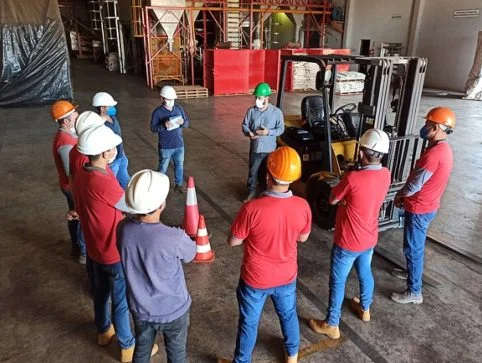
Every legitimate program rests on three required parts, and this is exactly why you can't fully certify from your couch:
- Formal instruction — the knowledge side: regulations, procedures, safety theory. This can be done online.
- Hands-on training — supervised practice on an actual forklift. This cannot be done online.
- Workplace evaluation — a qualified person watches you operate in your real environment and confirms you're safe. This cannot be done online.
OSHA defines "qualified evaluator" broadly, so an experienced supervisor can usually handle the last two steps in-house. My one caution: don't treat these as boxes to tick. The evaluation is where I've caught the habits that get people hurt.
One Forklift Doesn't Fit All
You're never certified to drive "forklifts" as a category. OSHA requires training matched to the specific class you'll run — sit-down riders, stand-up models, narrow-aisle reach trucks, pallet jacks, truck-mounted units, order pickers, aerial lifts.
A counterbalance operator stepping onto a Raymond order picker for the first time is, effectively, a beginner again. When you enroll, confirm the course covers the machine you'll actually operate.
Your Roadmap: Beginner to Certified
People always want the shortcut, but the truth is the process is simple if you do it in the right order. Here's how I tell every new operator to approach it.
Step 1: Decide which machine you'll be operating. Before you sign up for anything, know whether you'll be on a sit-down counterbalance, a stand-up reach truck, an order picker, or something else. Your training has to match the equipment, and starting here saves you from paying for the wrong course.
Step 2: Choose your training format. You have three options—fully in-person, online classroom plus in-person hands-on, or employer-provided training. If you already have a job lined up, employer training in your actual workplace is the best route. If you don't, an online classroom course is a convenient, affordable way to get a head start at your own pace.
Step 3: Pick an OSHA-aligned provider. Make sure the course content meets OSHA standards so your employer will accept it. When you enroll in an online course, tell the provider exactly which type of truck you'll operate so they can tailor the classroom material to that machine.
Step 4: Complete the classroom (formal) training. This is the knowledge portion—regulations, safe operating procedures, load handling, inspections, and hazard awareness. This is the part you can finish online.
Step 5: Schedule your hands-on training. This cannot be done online. You'll get supervised, real-world practice on the actual forklift, learning the feel of the controls, the rear-end swing, and how a raised load changes the machine's balance.
Step 6: Pass your assessments. Expect a written test covering the classroom material and a practical skills evaluation—usually maneuvering, lifting, stacking, and a pre-operation inspection while a qualified evaluator watches.
Step 7: Get certified by your employer. Once you've passed both parts, your employer formally certifies that you're trained, evaluated, and competent on that specific equipment. That's the certification that actually counts—not the course certificate alone.
Let me tell you this—your friend can't do this. What I mean is, if a buddy tells you he can teach you to drive a forklift and get you certified, don't believe him. You're just wasting your time. He can't certify you. Only the designated trainer in your actual work environment can do that. So, are we clear?
Two Things That Catch Every New Operator Off Guard
This is exactly why becoming forklift certified is about real training, not just passing a test. Two things consistently catch beginners off guard, and neither one can be learned from a screen or a quick tip from a coworker.
- The first is rear-end swing: forklifts steer from the rear wheels, so the back end swings wide on turns in a way that shocks people used to driving cars.
- The second is the high center of gravity—a raised load, even one well under the weight limit, can tip the machine if you turn too sharply.
New operators fixate on the capacity number and assume "under the limit" means "safe." It doesn't. You only truly understand these things by feeling them under supervision, on the actual machine, during the hands-on portion of your certification.
These effects matter because they're the exact hazards forklift certification is designed to train out of you—a misjudged turn from rear-end swing or an overconfident lift with a high center of gravity is how tip-overs and collisions happen.
That's why getting certified means proving you can feel and control these forces on the actual machine, not just memorizing rules for a written test.
Timeline and Cost
How Lond Does It Take to Complete?
For most people the formal portion takes one to two days. Vocational programs run longer than employer training; in-person eats more time than online; specialized equipment like rough-terrain forklifts takes longer to master. Add hands-on practice and evaluation, and most new operators are job-ready within a few days.
| Class | Equipment Type (Examples) | Classroom (Formal) | Hands-On + Evaluation | Typical Total (New Operator) |
|---|---|---|---|---|
| Class I | Electric motor rider trucks (sit-down & stand-up counterbalance) | 2–4 hrs | 3–4 hrs | ~1 day |
| Class II | Electric narrow-aisle trucks (reach trucks, order pickers) | 2–4 hrs | 4–8 hrs | 1–2 days |
| Class III | Electric hand/hand-rider trucks (pallet jacks, walkies) | 1–2 hrs | 1–3 hrs | Half day |
| Class IV | Internal combustion, cushion (solid) tires — indoor | 2–4 hrs | 3–4 hrs | ~1 day |
| Class V | Internal combustion, pneumatic tires — indoor/outdoor | 2–4 hrs | 3–4 hrs | ~1 day |
| Class VI | Electric & IC tractors (tow tractors, tuggers) | 1–3 hrs | 2–4 hrs | Half to full day |
| Class VII | Rough-terrain forklift trucks | 2–4 hrs | 6–10 hrs | 1–2+ days |
How Much Does It Cost?
| Training Option | What It Covers | Typical Cost | Best For |
|---|---|---|---|
| Employer-provided training | Full process: classroom, hands-on, and on-site evaluation | Usually free to the employee | Anyone already hired—this is the ideal route |
| Online classroom course | Formal (theory) portion only; certificate of completion | $50–$150 | Getting a head start before you have hands-on access |
| In-person operator course (training center/school) | Classroom + hands-on practice + skills evaluation | $150–$350 | Job seekers with no employer to train them yet |
| Vocational/trade school program | Extended training, sometimes multiple machine types | $500–$1,500+ | Career changers wanting a deeper credential |
| Recertification / refresher | Updated theory + re-evaluation (required every 3 years) | $50–$100 (often free via employer) | Existing operators renewing their certification |
| Group / bulk employer training | Multiple operators trained together | Discounted per person (varies) | Companies certifying a whole crew |
Online courses are usually the cheapest, with some self-paced programs starting around $80. Employer-sponsored training may cost you nothing. In-person and vocational programs cost more because of equipment and instructor time.
A Lesson From the Laydown Yard
Let me tell you why I take the evaluation step so seriously.
On a construction site I worked, an operator was stacking pallets loaded with ten-foot H-beams in an open laydown area. He had all the room in the world to maneuver, which is part of how it happened. His spotter had drifted about fifteen feet behind the forklift and was buried in his phone — completely out of position, completely checked out.
The operator never saw him. He reversed and struck the spotter with enough force to throw him several feet and knock him unconscious. I ran the investigation, pulled in the operators for questioning, and wrote it up.
Here's what that day taught me, and what I now teach: a wide-open space isn't a safe space — it lowers everyone's guard. The spotter failed, but so did the system around him. After that, I built the incident directly into my training as a case study, because a near-fatal lesson is wasted if only the people who were there learn from it.
Why I Talk to Every Operator
Here's something most people don't realize about getting certified: the practical evaluation isn't just a mechanical test—there's a human on the other side of it, watching how you operate.
I once had a trainee fail the practical evaluation three times in a row. I'd never seen that. When I finally sat him down and asked what was going on, the truth came out: he was failing on purpose.
The company was reassessing everyone to move them to night shift, and he didn't want it—because he had insomnia, and a night schedule would have wrecked his health. He wasn't a bad operator at all.
I tell you this for two reasons. First, if you're the one getting certified, understand that the evaluation is about demonstrating real competence and good judgment, not gaming a checklist—a good evaluator can tell the difference.
Second, if you ever become a trainer or supervisor yourself, remember that what looks like a "performance problem" often has a human reason underneath. Certification measures skill, but safe operation depends on people, and people are never as simple as a pass/fail score.
Where the Textbook Diverges From the Floor
Here's something the courses rarely admit. Training is usually packaged by a trainer who doesn't know your specific worksite — your traffic patterns, your blind corners, your particular operators and their habits. Generic content can teach the fundamentals, but it can't prepare you for your floor.
The best training folds in real situations from the actual environment. When I train a crew, I want to know how their yard flows, where pedestrians cut through, which dock gets chaotic at shift change. That's where accidents actually happen — not in the textbook.
The Skill Most Articles Never Mention
If you ask me what separates a safe, valuable operator from a merely competent one, it's not smooth control or fast stacking. It's what I call the pedestrian sixth-sense — situational awareness in a busy space.
I've seen operators who were excellent at everything mechanical and still dangerous, because in a warehouse with people and trucks moving all at once, they'd narrow their focus to the load and forget the room.
The great ones keep a running map of where every person is, even the ones they can't currently see. You can teach controls in a day. This takes intention to build, and it's the difference that keeps people alive.
Daily Inspections — and the Industry's Dirty Habit
OSHA expects forklifts to be inspected before each shift (or after, for machines running continuously). You're checking for anything that compromises safety, and a forklift with a problem stays parked until it's fixed. Written logs aren't federally required, but they prove diligence, and some states — California, for one — expect safety records kept for up to a year.
Now the honest part. In the real world, I've watched plenty of employers cut corners: online-only training with no hands-on component, skipped evaluations, and "pencil-whipped" inspection checklists where someone signs off without ever looking at the machine.
Many don't monitor training or keep records at all. OSHA's standard is the floor, not the ceiling — and a lot of companies don't even reach the floor.
Staying Certified: Recertification and Refreshers
Certification isn't permanent. OSHA requires employers to re-evaluate operators at least every three years. Refresher training is also required sooner whenever you're assigned a new type of forklift, your work location or conditions change, you're involved in an accident or near-miss, or you're observed operating unsafely.
Beyond compliance, refreshers fight the complacency that creeps into experienced operators — often the most dangerous group, precisely because they've stopped thinking about it.
Choosing a Program and a First Job — With Red Flags
My honest advice: the best training happens with your employer, in the actual environment, on the actual forklift you'll run. Before you commit to a job, get a look at the work environment and meet the people who'll be working around the machine — how a crew behaves around equipment tells you everything.
And watch for red flags. If a company doesn't take safety seriously, you can spot it fast: no safety officer, no warning signage around the work area, low morale on the floor. Those places have high turnover for a reason. You won't last there, and you shouldn't want to.
The One Thing I Want You to Remember
A piece of paper doesn't make you safe. Certification is the entry ticket, not the destination.
Real safety comes from continuous, deliberate hazard awareness — and from a culture where anyone, from the newest warehouse hand to upper management, can stop an unsafe operation without fear of getting punished for it. I've trained 1,800 operators, and the ones I never had to investigate weren't the ones with the cleanest test scores. They were the ones who never stopped paying attention.
Get certified. Then keep earning it, every shift.