Let’s be honest: no forklift operator wants to be in an accident, and no supervisor wants to deal with one. It’s stressful, chaotic, and it shakes everyone up. But here’s something most people don’t realize — workers who’ve been involved in an accident often become the strongest safety advocates on the jobsite.
I’ve seen it happen again and again throughout my years in safety and operations. The guys who used to ignore PPE or rush through tasks suddenly become the ones reminding their co-workers, “Hoy, ingat. I’ve been there.”
This article is all about how to orient workers involved in an accident in a way that helps them recover mentally, understand what happened, and eventually step into a more powerful role: being a safety advocate who prevents the next accident.
Why Accident-Involved Forklift Operators & Workers Can Become Powerful Safety Advocates
Most safety programs focus on rules, checklists, and procedures. That’s good — but nothing hits harder than real experience. When someone has gone through an incident, even a minor one, something shifts.
Here’s what I’ve personally seen:
- They understand risks more deeply.
- They have firsthand knowledge of what went wrong.
- Other forklift operators listen to them because they’re “one of us.”
- Their stories carry emotional weight — something textbooks can’t replicate.
- They can influence behavior quietly but effectively.
This is why learning how to orient workers involved in an accident properly is one of the most effective ways to improve safety culture.
Communication Do’s and Don’ts After an Accident
| Do | Why This Works | Don’t | Why It Causes Problems |
|---|---|---|---|
| Ask how the worker is feeling first. | Builds trust and lowers defensiveness. | Start with “What did you do wrong?” | Makes the worker shut down and feel blamed. |
| Use a calm, friendly tone. | Helps the worker open up and share honestly. | Raise your voice or sound frustrated. | Increases fear, embarrassment, and resistance. |
| Let the worker tell their story without interrupting. | You get the real version, not the defensive version. | Cut them off or correct them mid-sentence. | Worker feels judged and withholds important details. |
| Normalize their emotions (fear, embarrassment, guilt). | Makes them feel understood and supported. | Ignore or downplay emotional impact. | Worker carries emotional stress and loses confidence. |
| Focus on lessons and prevention, not blame. | Encourages growth into a safety advocate. | Turn the conversation into a fault-finding session. | Creates shame, which kills motivation to improve. |
| Thank them for being honest and cooperating. | Reinforces positive behavior and trust. | Act cold or transactional. | Worker feels like “just another case” instead of a valued team member. |
| Ask for their ideas on solutions. | Gives them ownership and strengthens buy-in for safety. | Make all decisions without their input. | Misses valuable insights and makes them feel powerless. |
| Follow up later to check on them. | Shows genuine care and builds long-term safety commitment. | Forget about them after the report is done. | Worker feels abandoned and unlikely to advocate for safety. |
How to Orients Operators or Other Workers
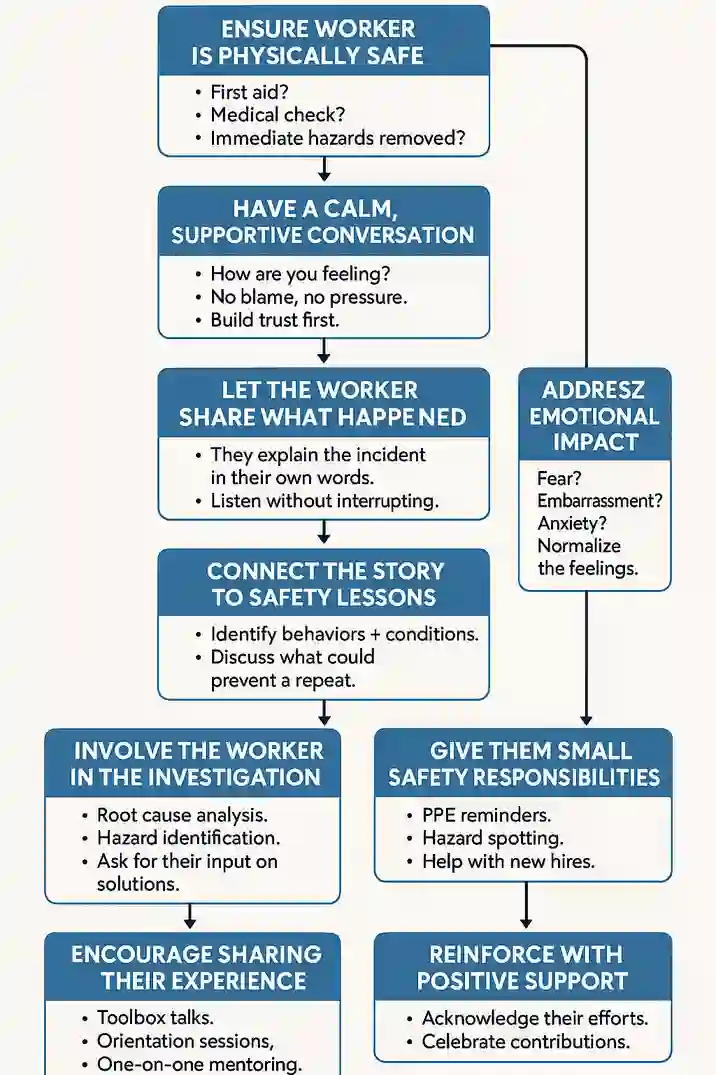
Start With a Calm, Supportive Post-Accident Conversation (Not Blame)
Right after an incident, most companies jump straight into interviews and reports. Pero sa totoo lang, that’s not the best first move.
From experience, the first step should always be a simple, human conversation.
When I orient a forklift operator after an accident, I always start with:
“Bro, how are you? Let’s talk about how you’re feeling.”
Not:
“Why did you do that?”
“What went wrong?”
“Whose fault it is?”
If you want them to eventually become a safety advocate, they must first feel safe, not attacked.
Don’t Ignore the Emotional Impact — It Affects Safety Behavior
One thing I learned in the field: accidents hurt more emotionally than physically.
Operators often feel:
- embarrassed
- ashamed
- scared
- guilty
- worried about reputation
- unsure about returning to work
I’ve had workers tell me:
“Sir, I’m embarrassed to come back. I’m afraid I might get laughed at.”
A proper post-accident orientation lets them talk about these feelings casually. Once the emotional weight is lighter, they become more open to learning — and teaching others.
If we want them to grow into safety advocates, we must handle the emotional side with respect.
Turn Their Experience Into Practical Safety Lessons
Here’s where the magic happens.
After the operator opens up and becomes more comfortable, start connecting their experience to real safety lessons. This turns the accident into a teachable moment not only for them but eventually for the entire team.
Examples:
- “You slipped because the floor wasn’t clean. Let’s figure out how we can prevent that.”
- “You rushed because you wanted to finish early — a lot of people make that mistake. You can help others avoid it.”
- “Your injury came from a small decision. Imagine how many others do that without realizing.”
These insights later help them become authentic safety advocates — the type workers actually listen to.
Involve Them in the Accident Investigation (This Builds Ownership)
This is one of the most powerful strategies for turning accident survivors into safety leaders.
Instead of excluding them or treating them like the “cause,” involve them directly in:
- hazard identification
- root cause analysis
- discussing corrective actions
- evaluating what controls failed
- suggesting practical improvements
One time, a forklift operator suggested adding a lockout-tagout board near his station after an electrical incident. His idea got implemented — and he became the loudest advocate for LOTO afterward.
When workers feel ownership, they naturally step into the role of a safety champion.
Encourage Them to Share Their Story (This Is What Changes the Entire Workforce)
Some companies make operators sign papers and sit through seminars. That’s fine — but what really changes behavior is a real story told by a real worker.
During toolbox talks or orientation sessions, I sometimes ask workers who are ready to share a short message:
“Guys, hindi worth it magmadali. Eto nangyari sa akin dahil nag-shortcut ako.”
You can hear a pin drop when a worker speaks like that. Everyone listens.
But — and this is important — never force anyone.
Some forklift operators take days to open up; others take months.
When they’re ready, their story becomes one of your strongest safety tools.
Give Them Small Safety Roles First (Build Confidence Slowly)
Don’t expect them to immediately become full-fledged safety officers. Start with simple tasks:
- reminding coworkers about PPE
- reporting hazards
- helping with housekeeping
- joining safety walk-arounds
- assisting new hires
- demonstrating safe techniques during talks
Small responsibilities build confidence. Confidence builds leadership. Leadership builds safety advocates.
This gradual involvement is exactly what people look for when searching how to orient workers after an accident.
Reinforce Their Growth and Recognize Their Efforts
Operators become safety advocates faster when they feel valued.
You don’t need certificates or awards. Often, small genuine comments work best:
- “Good job reminding the crew earlier.”
- “Your suggestion made a big difference.”
- “Thanks for helping the new guys.”
- “Your story earlier was powerful.”
People repeat what they feel appreciated for.
Recognition = motivation.
Mistakes to Avoid When Orienting Accident-Involved Workers
Now let me save you from some mistakes I’ve personally witnessed (and sometimes committed):
❌ Don’t embarrass them publicly
Never make them feel like the “example” of what not to do.
❌ Don’t rush them into speaking
Some need time to process before they’re ready to share.
❌ Don’t weaponize their story
Using it as a scare tactic destroys trust.
❌ Don’t isolate them
That only increases shame and reduces learning.
❌ Don’t ignore their emotional recovery
A mentally stressed worker cannot truly be an advocate.
Avoiding these mistakes makes your orientation process smoother — and keeps morale intact.
Indicators That a Worker Is Becoming a Safety Advocate
| Behavior | What It Means | Suggested Support |
|---|---|---|
| They start reminding coworkers about PPE and safe practices. | They’re becoming more aware of hazards and taking responsibility for others. | Acknowledge their effort, encourage them to keep sharing reminders. |
| They openly discuss their accident experience when relevant. | They feel comfortable turning their story into a teaching moment. | Invite them (but don’t force them) to participate in toolbox talks. |
| They report hazards more frequently and earlier than before. | They’ve developed a proactive mindset instead of waiting for problems. | Give positive feedback and act quickly on their reports. |
| They participate actively in safety meetings and investigations. | They see themselves as contributors to safety culture, not just workers. | Involve them in small safety tasks or committees. |
| They help new workers learn safe behaviors. | They’re stepping into a peer-mentor role naturally. | Pair them with new hires during orientation or early tasks. |
| They ask questions about why procedures exist. | They’re moving beyond compliance and into understanding. | Give clear explanations, maybe assign small responsibilities. |
| They volunteer suggestions to improve safety procedures. | They’re thinking like problem-solvers, not just rule-followers. | Explore their ideas, implement good ones, and give credit. |
| They show more confidence and calmness around safety discussions. | They’re becoming comfortable as someone others look to for guidance. | Provide ongoing support and occasional check-ins. |
| Coworkers start asking them questions about safety. | This means others see them as a reliable resource. | Encourage the role but avoid overwhelming them. |
| Their attitude toward shortcuts changes—they now call them out. | They’ve internalized the cost of unsafe behavior and want others protected. | Reinforce that their voice matters and makes the team safer. |
Final Thoughts: Accidents Are Painful, But They Can Create Safety Champions
Here’s the truth I’ve learned as someone who’s handled many incidents:
Workers who go through accidents often develop a deeper understanding of safety than anyone else on the team.
Their stories, their lessons, their reflections — these things shape safety culture far more than posters, presentations, or rulebooks.
When you orient them with:
- empathy
- involvement
- ownership
- respect
- genuine conversation
…you turn a painful moment into a powerful transformation.
And at the end of the day, safety advocacy isn’t about rules — it’s about people looking out for each other.