
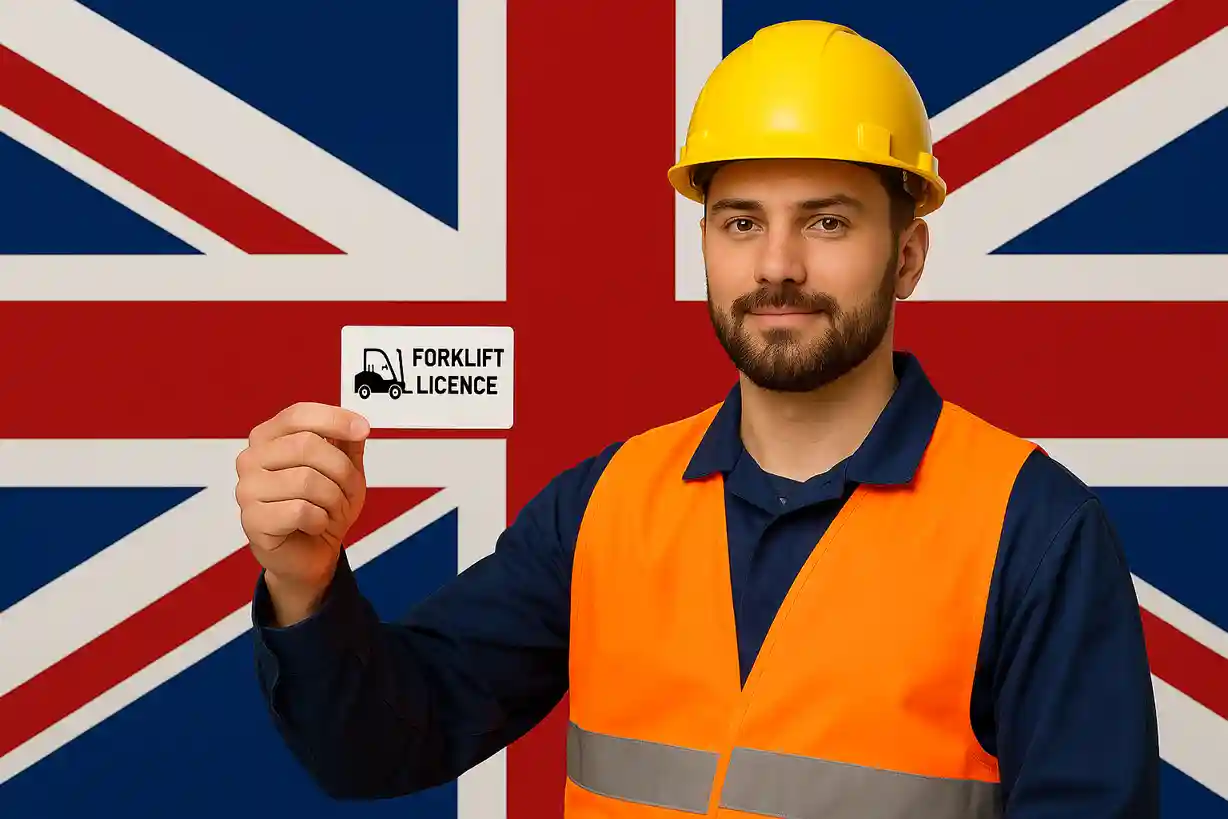
If you’re thinking about becoming a forklift operator in the UK, good choice — it’s one of those jobs that’s always in demand, pays decently, and gives you a skill that can take you to warehouses, construction sites, factories, ports… basically anywhere things need lifting.
But here’s something a lot of beginners get confused about:
The UK doesn’t actually have a “government-issued forklift licence.”
No DVLA card. No official government test.
Instead, you complete accredited forklift training, and that certificate is what employers treat as your “forklift licence.”
Don’t worry — it’s not complicated, and you don’t need prior experience to start. I’ll walk you through everything based on what actually happens in the real world, not the textbook version.
Let’s break it down.
Getting Your Forklift Licence (Step-by-Step)
To get a forklift license in the UK, here's what you need to do in simple terms:
| Step | Action | What Happens | Notes / Tips |
|---|---|---|---|
| 1 | Choose Forklift Type | Pick the type of truck you want to train on (e.g., counterbalance, reach truck, telehandler) | Warehouse jobs usually want counterbalance + reach truck |
| 2 | Select an Accredited Training Provider | Book your course with RTITB, ITSSAR, NPORS, or AITT accredited centres | Avoid unaccredited providers; employers may reject their certificates |
| 3 | Attend Classroom Theory | Learn about safety, stability principles, hazards, and load handling rules | Most centres use videos and real-world examples — no boring lectures |
| 4 | Complete Practical Hands-On Training | Practice driving, lifting, stacking, reversing, inspections, and manoeuvres | Don’t worry about mistakes — instructors guide you step by step |
| 5 | Take the Written Test | Multiple-choice questions on safety, stability, and forklift theory | Most first-timers pass easily with a little review |
| 6 | Complete the Practical Driving Test | Demonstrate safe operation, pre-use checks, stacking, and route navigation | Stay calm and drive smoothly — safety is more important than speed |
| 7 | Receive Your Certificate | You get an operator certificate and sometimes a photo ID card | This is what employers recognise as your “forklift licence” |
| 8 | Begin Job Applications | Use your certificate to apply for forklift jobs or operate at your workplace | You will still need site-specific training for each workplace |
Here's a Video Explaining How the Practical Training is Being Done:
Forklift Training Accrediting Bodies
The Health and Safety Executive (HSE), being the regulatory authority in UK, set forth forklift training standards to follow. The HSE acknowledges only these six (6) accrediting companies, namely:
- Association of Industrial Truck Trainers (AITT) - www.aitt.co.uk
- Independent Training Standards Scheme and Register (ITSSAR) - www.itssar.org.uk
- Lantra Awards - www.lantra-awards.co.uk
- National Plant Operators Registration Scheme Ltd - www.npors.com
- Road Transport Industry Training Board (RTITB) Ltd - www.rtitb.co.uk
- Construction Industry Training Board, (CITB) – www.constructionskills.co.uk.
These accrediting bodies have created their own training standards. They accredit training providers such as companies, schools, individuals who want to become qualified instructors and employer training schemes.
So when enrolling in a course, make sure the training center is accredited by one of these bodies.
Identifying the Skills You Already Have Will Determine the Training Course You Need to Take
| Training Type | Duration | Best For | Notes |
|---|---|---|---|
| Novice Training | 3–5 days | Beginners with zero forklift experience | Includes full theory, hands-on practice, and both written & practical exams |
| Experienced Operator | 1–2 days | Operators with experience but no formal certificate | Skills assessment is required before taking this course |
| Conversion Training | 1 day | Operators moving to a different forklift type (e.g., counterbalance → reach truck) | You must already have a valid certificate for your original truck type |
| Refresher Training | 1 day | Operators renewing their licence (usually every 3–5 years) | Required after long breaks, accidents, or unsafe behaviour |
Requirements Operators Must Have in Order to Get a Licence
- Completion of a training course. This is the foremost requirement an operator must take in order to earn a forklift driving licence in the UK. Please refer to above information for the steps needed to take. The course consists of theory and practical training and at the end is the skills assessment.
- For those who are new to this, you need to be at least 17 years old to be accepted in the training; This is age is the minimum school leaving age which is allowed to work as a forklift operator in the UK. In a more dangerous workplace such as ports, an operator must be at least 18 years old because of the inherent nature of the work area.
- Even you have significant experience as a forklift operator, refresher training is needed in order to maintain qualifications and of course to keep licence. Refresher training is taken every three (3) years. But then again, there is no specific time in order to take the refresher training as there are many circumstances that prompt the operator to undergo refreshers such as involvement in a near miss or accident, learning of new skills, development of unsafe work practices, deficiency in operating skills, etc.
- Due to the nature of the job, operators are expected to be in optimum physical and health conditions. Operating this potentially dangerous piece of equipment for a long period of time every day requires good stamina. Operators may be required by their employer to undergo a medical exam to determine physical ability.
- Do you need a driving licence? There’s a lot of confusion about this. In reality, a driving licence in not required in order to operate a forklift truck. Not unless the truck will be driven on public roads. If such a circumstance arises, then the operator must have a driving licence issued in the UK and should comply with the road traffic rules.
How Much Does Forklift Training Cost?
In the UK, forklift training usually costs between £200 and £650, depending on several factors:
1. Course Duration
Training time varies depending on your skill level:
- Novice operator: 3–5 days
- Experienced operator (but no valid certificate): 2 days
- Refresher or conversion course: 1 day
- Advanced or specialised training: May take longer
HSE’s ACOP L117 (Appendix 1 & 2) outlines expected training hours, and longer courses naturally cost more.
2. Type of Forklift You’re Training On
Some forklift types are more complex and cost more to train on:
| Forklift Type | Typical Cost |
|---|---|
| Counterbalance | £250–£400 |
| Reach Truck | £300–£450 |
| Pallet Truck / PPT | £150–£250 |
| Telehandler | £500–£650 |
| Rough Terrain / Industrial Trucks | £500+ |
3. Accreditation Level
Training accredited by recognised bodies such as:
- RTITB
- AITT
- ITSSAR
- NPORS
…may have different pricing structures. Accredited training usually costs more but is widely accepted by UK employers.
4. Location of Training
Training in major cities like London or Manchester tends to be more expensive due to higher operating costs.
Meanwhile, training centres in smaller towns may offer cheaper rates.
5. Individual vs On-Site Company Training
If you're an employer, you can bring the trainer to your site. This can be cost-effective because:
- You avoid travel fees for employees
- Training uses your actual workplace equipment
- You can train multiple employees at once
Most providers offer better rates for group bookings.
Funding and Financial Support Options
Good news: you don’t always have to pay the full amount yourself. There are several ways to reduce the cost.
1. Government Grants & Employment Support
Depending on your situation, you may qualify for:
- Jobcentre Plus training support
- Adult Education funding (varies by region)
- Local employability programs
These schemes may cover part or all of your training, especially if you’re unemployed or retraining for work.
2. Employer Funding
Many employers cover forklift training costs because they legally must ensure operators are trained and competent.
Employer Sponsorship
Companies may:
- Fully pay for training
- Pay a portion of the cost
- Require you to stay with the company for a set time in return
Reimbursement Policies
Some employers will reimburse training once you pass, but you may need:
- Proof of certification
- A commitment agreement (e.g., stay for 6–12 months)
3. Financing & Loans
Some training centres and private lenders offer:
- Payment installment plans
- Short-term loans for vocational training
These usually come with interest, so check the terms carefully.
Training Quality and What You Get for the Cost
High-quality training usually includes:
- Low student-to-trainer ratios (commonly 1:3)
- Hands-on training using real forklift equipment
- Theory and practical assessments
- Certificates recognised nationally
A smaller training ratio ensures you get more one-on-one time, making you more confident and job-ready.
| Skill Level / Course Type | Duration | Cost Range |
|---|---|---|
| Novice Operator | 3–5 days | £300–£650 |
| Experienced Operator | 2 days | £200–£400 |
| Refresher Course | 1 day | £150–£250 |
| Conversion Course | 1 day | £150–£250 |
| Specialised Trucks (Telehandler, Rough Terrain) | 3–5 days | £500–£650 |
Renewal of the Forklift Licence in the UK
When to Renew Your Licence
- Every 3 Years: Generally, a forklift licence in the UK is good for about three years. When it's getting close to this time, you should start thinking about renewing it.
The Renewal Process
- Refresher Course: To renew your licence, you'll usually need to take a short training course. This is called a refresher course. It's not as long as your original training, but it's important to make sure you're still up to speed with all the safety rules and operating procedures.
Why It's Important
- Staying Safe and Legal: Renewing your licence is crucial. It's not just about being allowed to drive a forklift; it's also about making sure you're doing it safely. The rules and ways of operating forklifts can change, so it's important to stay updated.
Technical Details
-
Certificate Validity: The certificate you get after your refresher course proves that you're qualified to operate a forklift. Make sure you keep this certificate safe because your employer might ask to see it.
-
Types of Forklifts: Remember, if you operate different types of forklifts (like counterbalance or reach trucks), you might need specific refresher courses for each type.
Costs and Booking
-
Cost for Renewal: The cost to renew your licence will probably be less than what you paid for your initial training. Prices vary, so check with your training provider.
-
How to Book a Course: You can book your refresher course through a training center. It's a good idea to do this a few months before your licence expires so you're not in a rush.
In simple terms, renewing your forklift licence every three years is a must. It involves taking a short course to brush up on your skills and knowledge. This keeps you safe and legally compliant. The process includes a bit of time and cost, but it's an essential part of being a forklift operator.
The HSE and BSC Have Their Own Requirement
The Health and Safety Executive (HSE) says that “a person who operates a forklift truck on behalf of an employer must have received adequate training in its use”. The HSE also says that an operator must be “ competent”.
The British Safety Council (BSC) is an independent, not-for-profit organization that works to raise standards of health, safety and environmental management. The BSC is accredited by the HSE to provide training and qualifications, including forklift operator training.
The BSC’s website has a searchable database of accredited training providers. The website also has a list of Frequently Asked Questions about forklift operator training, including information about conversion courses for foreign licence holders.
The HSE’s website has a factsheet about operating a forklift safely. The factsheet includes information about the legal requirements for training and competence, as well as practical advice on how to operate a forklift safely.
Are Foreign Forklift Licence Valid in the UK
If you're considering operating a forklift in this country, you might question the validity of your foreign forklift licence. The simple answer is "No." This country has its distinct requirements and standards for training forklift operators.
While you can use a certificate from another country as proof of experience when seeking employment in the UK, you will still need to undergo training from an accredited provider specific to the type of truck you plan to operate in order to obtain a UK forklift certificate.
Don't Believe These
If one of your buddies told you that you can use your foreign forklift certificate if you intend to move to UK, that might not be true. Don't immediately believe if you hear these from your colleagues:
- The licence issued by a recognized and reputable organization will be valid in a new country - (This isn't true).
- The licence is for the same type of forklift as the one being operated in the UK - (even if you intend to operate the same type of forklift, you still need to take separate training).
- The licence is still valid and has not expired - (even if your foreign licence isn't expired, you still have to have a UK forklift certificate. The foreign licence you're holding is proof of experience operating the truck).
- The holder of the licence is competent to operate the forklift and has the necessary skills and experience - (Yes, this is true, but again to work in the UK as a forklift driver, you need to have the certificate issued in this country).
Different countries have their own standards with regard to training forklift drivers. If you intend to move to another country and work there as an operator, the foreign license you have can be used as evidence of experience when applying for a job.
Overall, getting a forklift licence in the UK is a fairly simple process. You just have to register for a course offered by a training provider, you should be able to operate a forklift without any problems. The course only takes a day or two, depending on the skill level you have.
Why Take Refresher Courses?
1. Preventing Bad Habits & Complacency
Even experienced operators can slowly drift into unsafe habits. Refresher courses act as a reset button, helping operators get back to proper, safe technique.
HSE notes that:
“Operators may easily become complacent or adopt unsafe working practices over time.”
Refresher training keeps safety front and center.
2. Staying Compliant With UK Regulations
While the law doesn’t force a set renewal period, employers are legally required under the Health and Safety at Work Act 1974 to ensure operators are trained, competent, and safe.
Refresher training is one of the easiest ways to prove this.
3. Improving Productivity and Efficiency
Refresher courses often include:
- Updated operating techniques
- New industry best practices
- Efficiency tips to improve workflow
This benefits both the operator and the employer.
When Is a Refresher Course Required?
HSE’s ACOP L117 outlines specific circumstances where refresher training is needed. Here’s a research-backed explanation of each one:
1. Regular Intervals (Every 3–5 Years)
This is the most common guideline.
HSE does not specify an exact number of years, but most UK training bodies (RTITB, ITSSAR, AITT, NPORS) and employers follow:
👉 Refresher training every 3–5 years.
This ensures operators stay competent even if nothing significant has changed.
2. After an Accident, Near Miss, or Unsafe Incident
If an operator:
- damages a pallet, racking, or equipment
- is involved in a near miss
- causes an accident
…it’s a strong sign that skills or awareness need refreshing.
HSE states refresher training is needed when:
“There is evidence of unsafe practice.”
3. When the Operator Has Not Used a Forklift for a While
Skills fade when not used.
If an operator returns after:
- extended sickness
- seasonal breaks
- job changes
- long holidays
…it’s best practice to give refresher training before they get back on the truck.
This ensures they’re confident and current with modern procedures.
4. When Workplace Conditions Change
Refresher training is needed when the environment changes, such as:
- new warehouse layout
- tighter aisles
- increased traffic
- new loading procedures
- different shifts or workflow
New hazards = the need for updated training.
5. When Switching to a Different Type of Forklift
You cannot use one licence for all truck types.
For example:
- Counterbalance ≠ Reach Truck
- Reach Truck ≠ VNA
- VNA ≠ Telehandler
HSE requires additional training whenever an operator uses a truck type they're not certified for.
6. After Introducing New Equipment or Technology
When a company introduces:
- new forklift models
- attachments
- automated systems
- new safety features
Operators must be trained on how this equipment works safely.
7. When UK Regulations or Company Policies Change
Any amendment to:
- HSE guidelines
- ACOP L117 requirements
- internal safety procedures
…calls for updated training so operators understand the new rules.
How to Get a Copy of Forklift Licence, If It Is Lost
To obtain a copy of your forklift license, you may need to follow these steps:
- Contact the training provider: If you received your forklift training and license from a training provider, you can reach out to them and request a duplicate copy of your license. They should have a record of your training and certification and can provide you with a copy of your license.
- Request a copy from the issuing authority: If you are unable to obtain a copy from the training provider or your records, you can contact the issuing authority, such as the Health and Safety Executive (HSE) in the UK, to request a duplicate copy of your license. You may need to provide some identifying information and pay a fee to obtain a duplicate copy.
It's important to have a copy of your forklift license, as it serves as proof of your competency to operate a forklift and demonstrates compliance with industry standards and regulations.
Additionally, having a copy of your license can be useful for job applications and for demonstrating your qualifications to potential employers.
If you have lost your license or it has been damaged, obtaining a duplicate copy is a necessary step to ensure you have the proper documentation to continue operating a forklift.
To Verify Your Credentials, Visit the RTITB Website
RTITB (Road Transport Industry Training Board) is a UK-based organization that provides training and certification for forklift operators. If you have received RTITB certification, you can check the status of your certificate by following these steps:
- Visit the RTITB website: Go to the RTITB website (www.rtitb.co.uk) and click on the "Check a certificate" link under the "Certification" section.
- Enter your details: On the "Check a certificate" page, enter your first name, last name, and certificate number. If you don't have your certificate number, you can also search for your certificate using your date of birth and postcode.
- Review your certificate: Once you have entered your information, the RTITB website will display information about your certificate, including the date it was issued, the type of certificate, and its expiration date.
If you are unable to find your certificate using the RTITB website, you can contact RTITB customer service for assistance. They can help you locate your certificate and provide you with the information you need.
It's important to keep your RTITB certificate up-to-date and to renew it if necessary. Having a valid RTITB certificate demonstrates your competence as a forklift operator and can be a valuable asset when applying for jobs or bidding on projects in the road transport industry.
Mistakes Beginners Make (Avoid These!)
❌ Choosing a non-accredited provider
If it’s not RTITB, AITT, ITSSAR, or NPORS, avoid it.
❌ Not knowing which forklift type they need
Counterbalance isn’t the only one — employers often ask for reach truck too.
❌ Thinking a forklift licence lasts forever
Nope. Most employers require refresher training every 3–5 years.
❌ Panicking during the test
Instructors want you to succeed. They’re not trying to fail you.
❌ Driving too fast
Almost every beginner does this. Slow and smooth wins every time.
What is Your Future as a Forklift Driver in the UK
The future of forklift drivers in the UK, as with many occupations, is influenced by various factors including technological advancements, market demands, regulatory changes, and the overall health of the economy. Here are some insights into the potential future for forklift drivers in the UK:
- Tech Changes: Some warehouses might use robots or machines that work by themselves. But, there will always be jobs that need people to help or watch over these machines.
- Jobs Available: More online shopping means more warehouses. So, there might be more jobs for forklift drivers for some time.
- Learning: Forklift drivers should learn the latest rules and ways to do their job. This will help them get better jobs.
- More Skills: If you can do more things, like use different machines or manage items in a warehouse, you might get better jobs.
- Rules after Brexit: The UK left the European Union, so some rules might change. Forklift drivers should know these changes.
- Move Up in Job: Experienced forklift drivers can get higher jobs in warehouses. They can become leaders or teach others.
- Money Factors: If the UK's money situation is good, there are more jobs. If it's bad, there might be fewer jobs.
In short, even with more machines and robots, there will still be jobs for forklift drivers. But, it's good for them to keep learning and adding new skills.
FAQs
Do you need a car driving licence?
No — only if the forklift will be used on public roads.
Can you fail the forklift test?
Yes, but it’s not common. If you don’t pass, you can retake it.
Is forklift certification transferable between employers?
Yes! Employers accept accredited certificates anywhere in the UK.
How long is the licence valid?
Typically 3–5 years, depending on your provider and employer policy.
To Wrap This Up
Getting a forklift licence in the UK is actually pretty straightforward, and it can make a big difference in your job prospects. First, choose the type of forklift you want to learn—counterbalance, reach truck, whatever fits your goals. Then, sign up for a training course that teaches you how to use it safely and correctly.
You’ll spend some time in the classroom going over the rules, and then you’ll hop on an actual forklift to practice the hands-on stuff. Once you’re confident, you’ll take a practical test to prove you can handle the truck safely. Pass it, and boom—you’ve got your forklift licence.
Just remember, you’ll need a refresher course every few years to keep everything up to date. It keeps your skills sharp and makes sure you’re following the latest safety guidelines.
Getting this licence can open up a lot of opportunities, especially in warehouses, construction, and logistics. It’s a solid step forward for your career.